Zoological Citation Notes --L
Bonasa umbellus labradorensis Citation
- The imprint date on the Journal is 1990,
however on the final page of the Index it notes:
"Mailing date of the previous issue 104(3): 20 February 1991".
2020.03.19
Ketupa zeylonensis leschenault Nomenclature
- I employ Temminck's original published spelling.
- No doubt reasons will be found to alter this, as nomenclatural
stability plays a weak second fiddle to grammatical and linguistic purity.
2019.02.07
Stephanoxis lalandi loddigesii Author
- The authority is conventionally attributed to Gould
- The original description can be seen here:PZS 1831 p.12.
and it states:
	Mr. Vigors exhibited several species of Humming-birds from the collection
	of Mr. John Gould, one of which, previously undescribed, had been dedicated to Mr. George Loddiges, F.L.S., &c.
	It approaches most nearly to the Trochilus Lalandei, Vieill., but may be distinguished
	from that bird... by the following characters: ..."
- The Code states: "...if it is clear from the contents that some person other than an author of the work is alone
responsible both for the name or act and for satisfying the criteria of availability other than actual publication,
then that other person is the author of the name or act."
- Gould's role here is not "clear": did he attribute the name "loddiges? Clearly he did, given Vigors' attribution.
Did he recognize the differences in plumage? Probably he did.
Did he prompt the "nomenclatural act" (the publication of this name and description)? This is not clear.
In 1831 Gould was emphatically not in the habit of publishing his taxa, and particularly not
in serial literature. (His first publication containing new names was, in fact, in 1831, in the book Cent.HimalayanBirds (with an imprint
date of 1832). His first publications in PZS were in 1832.
- Thus, my interpretation is that in the abscence of clarity regarding Gould's role, Vigors is the author of the name.
2014.11.10
Vanellus crassirostris leucopterus Citation
- Conventionally cited to 1889.
- The number in which this appears (no. 187 "Juli") includes a dateline on p.321 of
"Hann. Münden, October 1889."
Also on p.326 is the dateline:
"Dresden, den 10 November 1889."
So the imprint date of "Juli" is demonstrated to be incorrect.
- The first evidence that I know of for this being in existence as a published work is the
notice given in the 1891 Ibis p.616 where this number was noted as rec'd at the Zoological Soc. on
Jan. 14, 1890.
2014.04.06
Sarothura lugens Nomenclature
- Rendered as "lugeus" on p.176, but as "lugens" on p.244.
- Close examination suggests that he "u" in "lugeus" does not appear to be an upside down letter "n".
- On p.244 the name occurs not in a article by Böhm, but in "Bericht über die Januar-Sitzung." with Golz, Schalow, and Cabanis as authors.
2013.10.13; 2014.02.15; 2014.02.17
Lonnberg Citation
2011.10.09 -->
Actinodura egertoni lewisi Nomenclature
- Named by Ripley for Wilmarth S. Lewis (1895-1979), who is now know mostly for
his collection and study of Horace Walpole materials. Lewis created, developed and provided
endowed support for the Lewis Walpole Library. Located at the site of Lewis's home in
Farmington, CT., the library is now part of Yale University.
2011.08.29; 2011.08.30
Momotus lessonii Nomenclature
- If cited to Rev.Zool. the original description can be seen here:
Rev. Zool. 1842 p.174.
- Many authors spell the epithet lessoni with a single -i ending.
In this they are probably following CBBM 17:324, but not Peters
5:226, which has the correct -ii spelling.
- Cory 1918 in CBA 2 no.1 p.113 renders the original combination incorrectly
as "Momotus lessoni" but lists the combination as "Momotus lessonii"
(without comment).
2010.07.05; 2010.07.06
Treron apicauda laotianus Nomenclature
- Most frequently spelled incorrectly as "laotinus" (e.g.
Peters Checklist III:11; H&M 3rd:173;
HBW 4:202 (1997).
- We will have to see if those who embrace error because of their personal and parochial
sense of familiarity will attempt to invoke "prevailing usage" in support of what
appears to be a casual and understandable blunder.
Desperation may invoke calls for nomenclatural "stability" (which is never defined)
in support of a "pet name", wrong as it may be.
2010.06.22
Dicaeum ignipectus luzoniense Citation
- Peters Checklist 12:196 (= Salomonsen 1967) gives the page
number for this taxon as "p. 1" while infact it is "p. l"
as in lower case "L" - Roman numeral for 50.
- Thanks to Colin Jones for picking this up.
- HBW 13:802 (2008) to their very great credit, have the page number
correct.
2010.06.20
Peneoenanthe pulverulenta leucura Citation
- Often cited as as I did previously.
- Colin Jones points out (2010.03.13) that Dick Schodde noted that this name
was published essentially simultaneously in two locations, and that
Salvadori acted as first reviser in 1881.
Ornitologia della Papuasia e delle Molucche
2:88 in selecting the Ann.Mag.Nat.Hist. nomenclatural act.
2010.03.13
Speirops leucophaeus Nomenclature
- Often spelled leucophoeus, although in the original
description the spelling is leucophaea.
- The original combination is spelled correctly in the CBBM 9:200 (= Gadow 1884).
Sclater's Syst.Av.Aethiop. 2:681 spells the current combination
Speirops leucophaeus, but makes the diphthong look like "-œ-" in the
original combination.
- Peters Checklist 12:337 (= Mayr 1967) may have established the current
incorrect spelling fad.
- Thanks for Colin Jones for bringing this to my attention, and to Normand David for
confirming the appropriate current spelling.
2010.01.26
Anaplectes rubriceps leuconotos Nomenclature
- Previuosly (and conventionally) spelled "leuconotus"
though the original spelling is "leuconotos".
- This error may well have started with Sharpe 1890
CBBM 13:413, where the original combination
is incorrectly listed as "Ploceus leuconotus".
- Thanks to Colin Jones for picking this up.
2009.12.26
Tachycineta leucopyga Nomenclature
- Previuosly (and conventionally) listed as:
- See Mlikovsky & Frahnert 2009. "Nomenclatural notes on Neotropical
swallows of the genus Tachycineta Cabanis (Aves: Hirundinidae)"
Zootaxa 2209:65-68. for a discussion of this name.
2009.08.29
Lamprotornis splendidus lessoni Citation
2009.06.20
Leach Authority
- The authority for bird names in this work is traditionally attributed
to William Elford Leach. Probability suggests that Leach is responsible for the names
but my reading of the work and of the ICZN Code suggests that attribution solely to
Leach does not seem to fully comport with the meaning of the Code. More correctly
the authority might be attributed to Leach & Koenig,KD, or possibly to Leach,
Koenig,KD & Brown, or less probably Tuckey, Leach, Koenig,KD & Brown.
- Page lxxxii of Tuckey's Narrative (1818) includes the following (note that the bird names
are in Appendix 4):
	The papers, No.2 and 3 in the Appendix, by Doctor
	Leach, and Sir Everard Home, respecting the parasitic
	Vermis....
		The other papers in the Appendix, illustrative of those
	subjects in the animal, vegetable, and mineral kingdoms
	which occurred along the lines of the Zaire, as far, at least,
	as the materials sent home would admit, were obligingly
	drawn up by Doctor Leach and Mr. Koenig of the British
	Museum, and by Mr. Brown, Secretary to the Linnean
	Society, and Librarian to Sir Joseph Banks; ...
- The relevant portion of the Code is:
	50.1.1. However, if it is clear from the contents that some person other
	than an author of the work is alone responsible both for the name or act
	and for satisfying the criteria of availability other than actual publication,
	then that other person is the author of the name or act.
	If the identity of that other person is not explicit in the work itself,
	then the author is deemed to be the person who publishes the work.
- The "author" of this work is largely Tuckey, though he died well before it was published.
The "Appendix" is essentially a separate work with multiple authors as designated in the
"Contents" and "Introduction", though responsibility for who did which part is not
"clear" from the contents. All in all, attribution of authority is
not clear (at least to me) from the wording of the Code.
- Therefore, it seems clear that Leach, Koenig, Home, and Brown are the authors
of the Appendices; Leach and Home are designated as the authors of the reprinted
material (App.2&3), Brown is designated as the author of the Botanical
material, and Leach and Koenig are the authors of the rest -- including Appendix 4
where the new names appear.
- It is reasonable to speculate that Leach is the author of the bird names, but it is
only a speculation, and is not clear from the contents of the work alone. Therefor
I attribute the authority for these names to the author(s) of the work (i.e. the
Appdeniceal material that is not otherwise specified as to author.
2009.06.06; 2017.12.03
Cutia legalleni Systematics
- As noted by the IOC World Bird names 2.0 (2009.02): "Cutia legalleni
is split from C.nipalensis (Collar 2006a, BLI 1.0)".
- H&M 3rd:617 makes no mention of this
(through Corrigenda 8, late 2008).
2009.03.07
Poliolais lopezi Nomenclature
- Originally spelt lopezi.
- H&M 3rd:580 fn.7 refer to the lopesi spelling as an "emended" name, without
comment on whether the "emendation" is justified or not. The opinion is offered that this "emended" spelling
is "judged to be in prevailing usage".
- Through Corrigenda 8 (2008) no reference it made to published data in support of this judgement,
no indication is made of how this judgement was formed or on what data it is based,
and no argument is offered as to why this particular unsupported judgement should be accepted.
- I note and ignore this opinion.
- HBW 11:600,601 uses lopezi and discusses the spelling. The opinion is rendered there
(though again unsupported) that "prevailing usage also appears to be heavily in favor of retaining
"lopezi" as the correct name.
- In such a situation the only remotely reasonable course, it appears to me, is to use the original spelling.
2008.12.25
Poliolais lopezi Nomenclature
- Originally spelt lopezi.
- Subsequently Alexander "corrected" this to lopesi and this subsequent spelling has been used by some authors.
- H&M 3rd:565 fn.3 refer to this subsequent spelling as an "emended" name, without
comment on whether the "emendation" is justified or not, and go on to put forward the opinion that this "emended" spelling
is "in prevailing usage".
- No reference it made to published data supporting this opinion, and no indication is made of how this opinion was formed.
- I note and ignore this opinion.
2008.10.31
Galerida cristata leautungensis Nomenclature
- The Peters Checklist 9:61 (= Mayr & Greenway 1960) give the original
combination as Galerida leautungensis which is incorrect. It was described as
Alauda leautungensis.
2008.08.18
Leptopoecile Nomenclature
- H&M 3rd:539 shows this as a feminine genus group name.
- David & Gosselin. 2008. Dutch Birding 30:19 discuss this and hold the name
to be treated as masculine.
2008.07.22
Anthreptes longuemarei Citation
- The Peters Checklist 12:216 (= Rand 1967) cites this name as
Cinnyris longuemarei Lesson, 1831, Illustr. Zool., pl. 23.
and the name does
occur in that work in the text to pl.23. It is in livr.8 of Illustr.Zool. which most probably was
published in 1833 -- a fact probably not known to Rand.
- Gadow (1884) in CBBM 9:115 cites this as:
	Cinnyris longuemarii Less., Bull.Soc.Nat. XXV. p.242 (1831); id
		Ill. Zool. pl. 23 (1831).
. While Gadow gets the spelling of the name wrong,
he does note it's presence in Bull.Soc.Nat. -- which it seems Rand did not investigate.
- The name is in Bull.Soc.Nat. 25 on p.342, and published in June of 1831.
- Thus the Peters citation is incorrect, and those who change the date to 1833 (the correct date for Ill.Zool.)
are giving the wrong date, and implying the wrong citation.
- Thanks to Michael Rieser for bringing this to my attention.
2008.07.13
Corvus corax laurencei Nomenclature
- H&M 3rd:515 initially follows the incorrect
spelling laurenci -- apparently following Cramp 1994 (not seen). But this is
corrected in Corrigenda #3.
- The Peters Checklist 15:281 has the spelling correct.
- Of interest, the CBBM 3:15 (= Sharpe 1877) spells this lawrencii (!)
even though it appears that the text of the work indicates that this was named
for "Laurence, a late Viceroy of the Panjab" (Richmond Index).
- The only appropriately named fellow I can find, however, is
John Laird Mair Lawrence, 1st Baron Lawrence, GCB, GCSI, PC (4 March 1811 - 27 June 1879)
an Irishman who became a prominent British pro-consul and imperial statesman. He served as
Viceroy of India from 1864 to 1869, having earlier earned the sobriquet "Saviour of the Punjab".
He was raised to the peerage as Baron Lawrence, of the Punjaub and of Grately in the County of Southampton.
2013.09.27
- The Richmond Index suggests that Hume's name is spelled both as laurencei and as lawrencei
and further that the name is a junior synonym to Severtzov's "1872" name. Severtzov says he suspects
that Hume's Corvus lawrencei (his spelling) is his own Corvus subcorax "published in Dec. 1827"
(though he doesn't say WHERE it was published).
2008.05.22; 2013.09.27
Garrulus glandarius leucotis Citation
- I am uncertain exactly which publication has priority for this name. Peters Checklist 15:233
cites "Proc.As.Soc.Bengal, p.106" with no indication of knowledge of any possible uncertainty in the matter.
- The Richmond Index primarily lists "Stray Feathers II, 1874, no.4 June, 1874 p.443" with a note
beneath indicating it was read at the meeting of the Asiatic Society of Bengal on May 18th.
- Given the present uncertainty as to when the relevant issue of the Proc.As.Soc.Bengal was published,
I defer to the the June number of Stray Feathers, but subsequent data may support the alternative case.
2008.05.14
Henicopernis longicauda Nomenclature
- Conventionally cited as:
- My work indicates that the name Falco longicauda Garnot 1828 (or Lesson & Garnot 1828) appears to be
preoccupied by Falco longicaudus Wilkes 1805.
Richmond Index card.
- The Wilkes name is listed in Sherborn's Index Animalium (p.3639, 1927) and the name
is listed in Cassin's 1867 (PANSP) discussion of the Encyc.Lond.
- Wilkes was describing an African bird, and his name was a junior synonym of
Falco albescens Daudin 1800, which in turn was junior to Falco albescens Boddaert 1783.
- CBBM 1:341 in the synonomy of Henicopernis longicauda lists
"Daedalion longicauda Lesson Traité p.67 (1831)"; this is also listed
in Strickland's Orn.Syn. (1855) where that name is listed in the synonomy of Astur longicaudus (p.120).
- Lesson's entry in Traité Orn. can be seen here: Daedalion longicauda Lesson.
- Steven Gregory has helped me greatly in understanding this problem, and points out that absent the
listing in Sherborn (and I add in the Richmond Index) no use of Wilkes' name is found -- which
renders it a nomen oblitum, so the name remains cited to Lesson & Garnot, and remains as the type.
2008.04.19; 2008.04.20
Automolus lammi Systematics
- For elevation to species status, see Zimmer,KJ. 2008. "The White-eyed Foliage-Gleaner
(FURNAIDAE: AUTOMOLUS) is two species." WilsonJ.Orn. 120:10-25.
2008.03.19
Haliaeetus leucoryphus Citation
- Peters Checklist 1(2):300 cites this to p.454 and volume I.
- As Jan Kaiser noted (in litt. 2007.12.15) volume one of this publication
includes pp.1-384 so this could not be in "vol. 1".
- The Richmond Index indicates that this is first described on p.377, which
would be in vol. I.
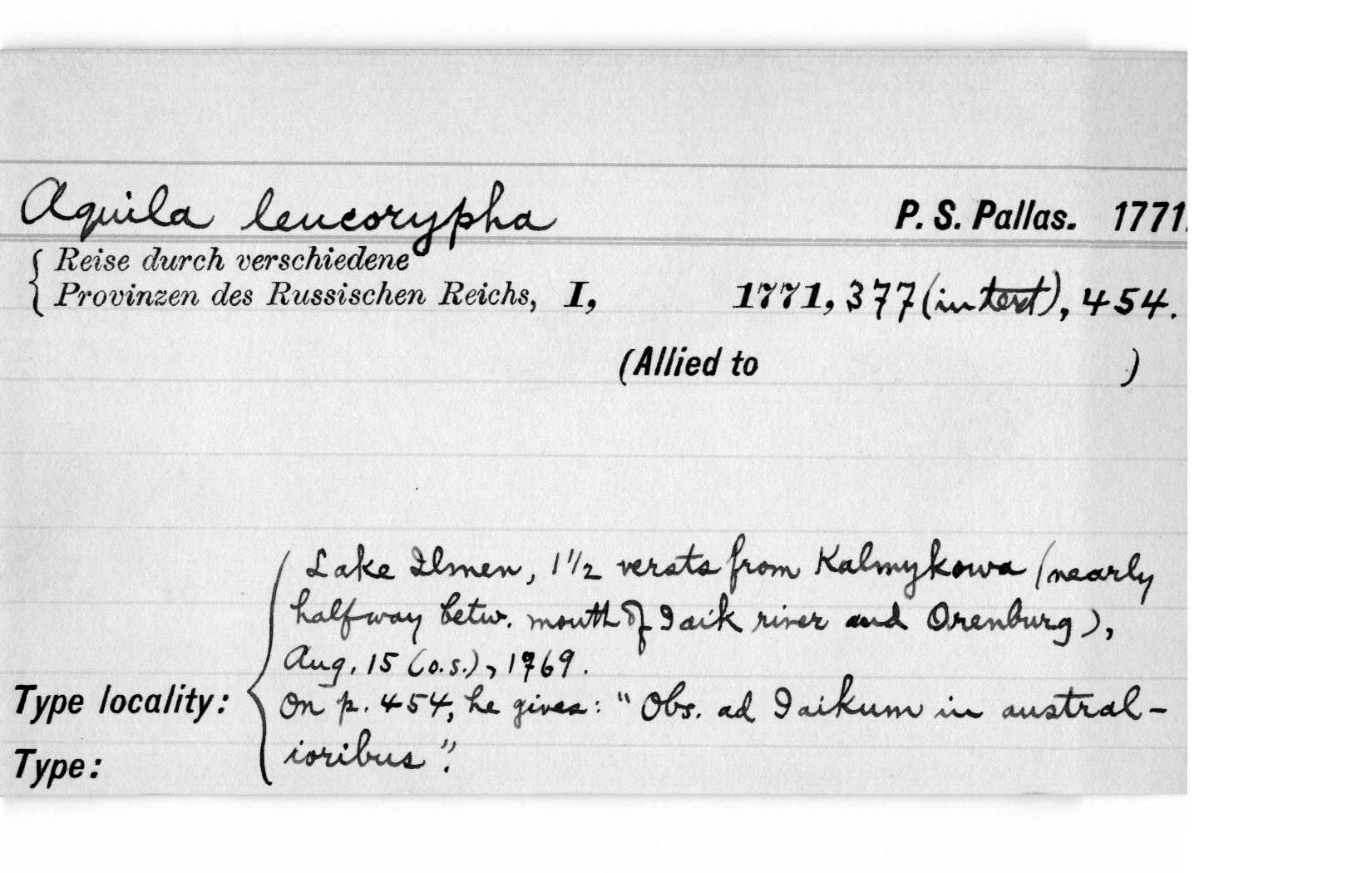
- Undoubtedly, the authors of this portion of the Peters Checklist
(Stresemann and Amadon) merely copied the citation and did not trouble to check it.
The CBBM I:308 may be the source of this erroneous citation. Sharpe gives
the citation there as:
Aquila leucorypha. Pall. Reis. Russ. Reichs. i p. 454 (1771).
Sharpe in turn may have attempted (without success) to follow Strickland 1855
Ornithological Synonyms. p. 52, where he has:
Aquila leucorypha, Pall. Voy. ii. p. 454. sp.5 ...
2007.12.15
Laniarius leucorhynchus Citation
- Peters Checklist
9:333 (= Mayr & Greenway 1960) cite this to "Rev.Mag.Zool."
which is an error. This is found in "Rev.Zool.".
- Mayr and Greenway appear to have been unaware of, or confused by the
publishing history of these serials. It certainly appears that they did
not examine the original materials.
- Of interest, two years (1962) later Mayr & Greenway 15:57 get the citation
correct for Sycobius st. thomae which is found on p.109 of this serial.
- Sclater in Syst.Av.Aethiop. II:617 has the citation correct
for this taxon, as does Gadow CBBM 8:132.
2007.08.25
Loriculus Systematics
- I incorporate the interpretations of Collar NJ, 2007. "Taxonomic notes on some insular
Loriculus hanging-parrots." BBOC 27(2):97-107.
2007.07.04
Tanagra cyanotis lutleyi Nomenclature
- Peters Checklist 13:379 (= Storer, 1970) lists the authority in parentheses. However,
Hellmayr established the replacement name (lutleyi) in Tangara so no parentheses are needed.
- H&M 3rd:812 correctly lists the authority without parentheses.
2007.05.05
Zonotrichia leucophrys Citation
- Peters Checklist 13:60 (= Paynter, 1970) gives the page number as "p. 340" which is
demonstrably ridiculous. In this volume, p. 340 is in an article about the Sieve of
Eratosthenes and is not by Forster. Presumably, Paynter transposed the digits of p.403, where
this description first occurs (it is repeated on p.426).
- The AOU CL, had the citation largely correct from editions 2 thru 5, citing p.426, but
with the 6th Ed. copied Paynter's error.
- The Richmond Index shows the page as "426 (+ 403)"
2007.04.18
Carduelis lawrencei Citation
- Peters Checklist 14:247 (=Howell et al., 1968) cites this to 1852, a
date which is not supported by any other authority. Howell et al. are unable or
unwilling to provide a rationale for this date, which conflicts directly with other dates
for this article given in other volumes of the Peters Checklist.
- H&M 3rd:751 follows this same dating, without
comment.
- Many sources, that evidently were not consulted by the Peters Checklist authors
show this date as 1850 -- a date supported by both logic and evidence.
2007.03.27; 2007.12.19
Citation
- Peters Checklist 13:182 (Paynter, 1970) cites this to 1860, and this
is followed by other
workers.
- This taxon was published in no.48, the number for "November" 1860.
- Also published in this number was Pezopetes, and Schulze et al. (p.2604) shows
this was published in May of 1861. The Richmond Index indicates that Pezopetes was published
30 May 1861.
- This date seems more believable than 1860, as a printers note attached to the cover of the
preceeding number (no. 47 "Sept.") indicates that it was not printed until Jan. 1861.
2007.02.18
Sterna hirundo longipennis Citation
- Peters Checklist 2:333 gives the citation essentially as
- However all the other Nordmann citations from 1835 differ from this.
Sherborn's Index Animalium confirms that this bird occurs in the same work as
all the other Nordmann taxa, and I list it accordingly.
2007.01.27
Phyllastraphus lorenzi Systematics
- Fishpool LDC. 2006. "Is the bulbul Phyllastrephus lorenzi a
good species?" BBOC 126(4):310-323. presents morphologic,
zoogeographic, and behavioural evidence in support of his argument that
P. lorenzi is probably a melanic form of P. icterinus
(Bonaparte 1850).
- H&M 3rd (through Corr. 8 December 2008) has no comment in this issue.
2006.12.31; 2008.12.02
Piranga leucoptera Nomenclature
- Listed by Peters Checklist 13:308 with the authority in parentheses, and this is followed by
H&M 3rd:819.
- Trudeau described this in Pyranga which is an 1816 Vieillot emendation of his 1808 name Piranga. (See for
example Neave Nomenclator Zool.).
- My interpretation is that the authority should not be in parentheses, as apparently interpreted by the
AOU CL. (1983 6th:660; 1999 7th:579).
- The Richmond Index questions the date of publication for this, 1840 versus 1839, and raises the
question that an "author's separate" may have been issued in 1839.
2009.08.01
- This taxon is dated by Peters Checklist 13:308 (= Paynter 1970) to 1839 without comment,
discussion, or presentation of evidence in support of this date. This date is also used by the AOU CL (6th & 7th), similarly without discussion or
comment. Sherborn's Index Animalium lists the date as 1840.
- This portion of the Journal (volume 8 Part I) was Presented to the Academy meeting
on May 5, 1840, which does not explicitly support a date of 1839.
- The Richmond Index raises the question of a possible author's separate, which may have
been published in 1839.
- However, until the presence of this putative author's separate is demonstrated an argument
can be made for using the date 1840 (and thus following Sherborn).
- More work needed.
2006.12.03; 2009.08.01
Cacicus chrysonotus leucoramphus Date
- H&M 3rd:769 cites this to 1844, but
cites other taxa from the same work (and same page) to 1845.
- The confusion arises from the confused and inconsistent rendering of
dates in the Peters Checklist. In this instance Blake (14:147)
lists two dates 1844 and 1845 but does not follow the convention of
putting one in parentheses.
- It may be that an imprint date of "1844" exists, in which case the
string ["1844"] would need to be added to all the citations from this
source.
- See AttiSestaRiun.Sci.Ital. for a discussion of this publication.
2006.10.22; 2006.11.04
Chlorostilbon lucidus Nomenclature
- The "Glittering-bellied Emerald" is usually refered to as Chlorostilbon aureoventris; I
had the citation as:
- Pachecho JF & Whitney BM. 2006. "Mandatory changes to the scientific names of three
Neotropical birds" BBOC 126(3):242-244. note that Trochilus lucidus was used since
1899, and is the valid name for this taxon.
2006.10.09
Dasyornis broadbenti litoralis Nomenclature Spelling
2006.08.14
Strix liturata Concept
- This original description is remarkably rare, and appears to have been seen by very few of even the
most industrious ornithological nomenclaturalists. The laudable and effective efforts of my colleagues
at "The Owl Project" have persisted and have a copy of the original description, it is here provided,
thanks to their efforts.
Strix_uralensis_liturata.pdf
2006.08.05
Pyrrhura leucotis Nomenclature
2006.07.27
Leptocoma 1851
- Peters Checklist 12:223 dates this name to 1851.
- This portion of Mus.Hein. has been interpreted as published in 1850, though further research on this
point may be of interest.
- Schulze et al. for example, clearly date this to 1851, and it appears that the 1850
interpretation (due I believe to Browning and Monroe) may result from data on a signature date,
rather than actual evidence of publication.
- The Richmond Index dates this as 1850, with the "0" crossed out with a "1" over written.
2006.06.12; 2008.06.25; 2019.11.17
Malurus leucopterus leuconotus Citation
Artamus cinereus melanops Citation
- A very minor, but (possibly) interesting point. Disagreement over the month date
of this publication:
- Duncan dates Part 1 to June, 1865
- CWR dates Malurus leucopterus leuconotus (in Part 1) to May, 1865
- Peters Checklist 11:396 (Mayr) to June, 1865 (? suggesting that in
this instance he referred to Duncan?
- Richmond also notes that the description was reprinted in July of 1865, in
Ann.Mag.Nat.Hist. ser.3 16:60.
- Similarly, the Richmond Index dates Artamus melanops (from the same page) to May; Mayr in Peters Checklist
15:164 does not provide a month date for this citation.
2006.04.16; 2007.09.06
Myzomela cardinalis lifuensis Citation
- Cited by Peters Checklist 12:359 (Salomonsen) to the author
"Layard".
- The Richmond Index indicates that the authors were both E.L. Layard
and E.L.C. Layard. This interpretation was confirmed by Dickinson
et al. in that the authority was corrected to include both
authors in the Corrigenda 3, based upon their examination of the
original description.
2005.11.12
Sylvia melanocephala leucogastra Concept
2005.10.08
Lophotis Citation
- Not surprisingly, there is confusion and uncertainty regarding the
citation for this name.
- The citations I have identified are:
- Peters Checklist 2:221 :
Lophotis Reichenbach, Syn. Av., no.3, Gallinaceae, 1848, pl.256, f.2175.
	Type, by monotypy, Otis ruficrista A. Smith
- Neave 2:997 :
Lophotis Reichenbach 1848, Synop. Avium, No. 3, [4]. — Aves
- The Richmond Index :
	Lophotis Reichenbach	1848
	Synopsis Avium, No. III, Feb. 1848, p.[4]
	Type by monotypy Otis ruficristata.
[APP: note ruficristata not ruficrista; apparently
a lapsus on the part of Richmond, as the Smith name is ruficrista
in the Richmond Index, as well as in my facsimile copy of Smith's paper.]
- Sherborn p.3671 :
Lophotis H.G.L. Reichenbach, Synop. Avium, No. III. Feb. 1848 [4]. — A.
- Schulze et al. p.1897:
	Lophotis [Subg.] ad Otis C.
	Linné | L. Reichenbach
	Handb. Orn. — Syn. Av.
	nr. 3 p.[6] 1848 II Av. Grall.
[APP: note p.[6] not p.[4].]
- A.B. Meyer in his 1879 Index of Reichenbach's works pp.6,42,123 (index):
Lophotis XXXI
2175. Lophotis ruficrista Sm. CCLVI. Ras.
Lophotis ruficrista Sm. CCLVI 2175
[APP: It appears that this may be where Peters got his information. My guess is
that the "XXXI"" refers to Reichenbach's use of the name in 1849 in Av.Syst.Nat.
where it occurs on pl.XXXI (and with no specific names associated).]
- HBW 3:727 :
Reichenbach (1848) Syn. Av. 3: 6, pl.256.
[APP: an interesting combination, looking like a combination of Shulze et al. and
Peters]
- The greatest agreement would appear to be found between Sherborn, Neave, and the Richmond
Index, though this certainly does not mean they are correct.
2005.09.10
Emberiza leucocephalos Nomenclature
- Originally spelled leucocephalos by S.G. Gmelin.
- Peters Checklist 13:8 (Paynter) spells this
leucocephala without comment, even though the original spelling
is correctly listed. One very likely possibility is that Paynter is
following Sharpe Cat.B.Br.Mus. 12:549.
- David N & Gosselin M. 2002. "Gender agreement of
avian species names." BBOC. 122(1):41 indicate that as
this is neither Latin, nor a Latinized word it must remain as originally
spelled.
2005.06.11
Ptilinopus viridis lewisii Nomenclature
- Originally described in Ptilopus and for this reason Peters
Checklist 3:36 places the authority in parentheses. This is
followed by H&M 3rd:177 and by HBW 4:221.
- It appears to me that Ptilopus is an 1841 Strickland
emendation of Swainson's Ptilinopus. As an emendation it appears
to me that it implies that the authority here should not be in
parentheses.
2005.05.03
Ptilinopus cinctus lettiensis Citation
- Originally described in Ptilopus and for this reason
Peters Checklist 3:27 places the authority in parentheses. This is followed by H&M
3rd:174, and by HBW 4:205.
- It appears to me that Ptilopus is an 1841 Strickland emendation of Swainson's
Ptilinopus. As an emendation it appears to me that it implies that the authority here
should not be in parentheses.
2005.04.26
Pseudocolapates lawrencii Citation Cantorchilus modestus zeledoni Citation
- Conventionally cited to 1878.
- The Bull. #193 of the Smithsonian Institution (p.40) indicates that "the exact
date of publication unknown."
- The Richmond Index lists this date as "1879?" and indicates that this number
(39) was published in "Jan. 1879?". The rendering of the question mark (?) looks
like it might be an exclamation point (!) in one instance, but in others is
clearly a question mark.
- Deignan (1961) p.245 dates this to "January? 1879?" and in this would seem to be
reflecting the availability of the Richmond Index when he was preparing his Type
list.
- I have not seen this number in person, but it appears reasonable to assume that
the imprint date is "1878". 1878 has been conventionally used, and the current ICZN
rules suggest that it may be required here.
Richmond's interpretation, as well as the pattern of publication of the Proceedings,
suggest that Jan. 1879 is very much more likely. Historical likelihood,
however, appears to be of less interest to the ICZN than "stability", which remains
undefined.
2005.02.25; 2009.05.06
Chalcophaps indica longirostris Citation
- Peters Checklist 3:115 cites the page number as "p.78", and
this is followed by HBW 4:612.
- The Richmond Index cites the page number as "p.79", which I
follow.
2005.02.15
Agriornis montanus leucurus Concept
- I am uncertain what the situation is on this taxon. My citation
(roughly) follows Peters Checklist 8:166 (Traylor).
- HBW 9:395 (A. Farnsworth & G.M. Langham) feel that the race
leucurus is indistinguishable from maritimus.
- The British Museum list of types gives a citation for this name
similar to what I use (differing in the representation of the part/volumes
of the work).
- W.E.D. Scott in 1900 described Agrriornis leucurus for this
bird in BBOC X no.LXXI p.lxiv, evidently in the belief that Gould's namd
was a nomen nudum.
- Those are a few of the confusing details I know of. In summary I am
confused and uncertain as to the status of the taxon and its
nomenclature.
2004.12.26
Leucopeza Date
- Peters Checklist 14:49 (Lowrey & Monroe) lists this date as
1877.
- Duncan and CWR show that this portion of the Proceedings was publishd in June of
1876.
- H&M 3rd:764 lists this as 1877, but it is to be corrected in
Corrigenda 3.
2004.10.17
Diopsittacus nobilist longipennis Citation
- Originally described by Neumann as Diopsitta nobilis
longipennis and now held to be in the genus Diopsittaca
Richmond.
This has understandably created confusion as to whether the authority
should be place in parentheses. [HBW 4:426 does not place the authority
in parentheses, but H&M 3rd:196 places the authority in
parentheses.]
- However, to date (2004.09.27) there is no evidence that anyone ever
erected a genus Diopsitta. If this is true then Neumann's rendering
can be regarded as a misspelling or an unjustified emendation. The ICZN
Code (1999) states (51.3.1):
 Parentheses are not used when the species-group name was originally
combined with an incorrect spelling or an emendation of the generic name
(this applies even though an unjustified emendation is an available name
with its own authorship and date).
- Certainty in this matter would be aided by examining the original
description (not seen).
- In consideration of this problem, Steven
Gregory adds useful additional understandings (in litt.2004.09.27):
I think I can give another twist to this --
the date of Neumann's introduction of the combination "Diopsitta" nobilis
longipennis (1931) is instructive, in that it is too late to introduce a new
generic name by means of a new binomen (or trinomen) alone. In other words there,
presumably, is no 'Intent to differentiate' as defined by Recommendation 13A, nor
(again presumably) is there the express fixation of a type species as required by
Art. 13.3.

I would therefore conclude that "Diopsitta" is an incorrect subsequent
spelling of Diopsittaca and that brackets should not be used.

The caveat is, of course, unless the original paper introducing
longipennis gives a contraindication to this assessment!
2004.09.27
Amazona autumnalis lilacina Concept
The original description is as follows:
  122. Amazona (psittacus) Lilacina,

		Lesson, esp. nouv.

	Corpore viridi; fronte rubro, sincipite
lilacino; abdomine, tectricibusque inferio-
ribus viridiluteus; speculo igneo super alas
et remigum parte terminali nigro cœruleo.
Gayaquil.

  Le perroquet à occiput couleur de lilas,
appartient à la tribu des Amazones, petite
coupe que Swainson a nommée Chrysotis en
1837, et qui répond à la majeure partie des
Androglossus de Vigors. Les perroquets ama-
zones appartiennent à l'Amérique équatoriale
et celui que nous décrivons ici, vit aux alen-
tours de Gayaquil, sur les rivages de l'Océan
pacifique.
  De perroquet mesure 32 centimètres de
longueur totale. Son bec a le ruban de son
aréte convexe assez étroit. Il est renflé sur le
côté, et de nuance brunâtre ou de corne, ses
tarses courts et robustes sont noirâtres ainsi
que les ongles.
  La forme du corps ne diffère point de celle
des autres amazones. Les ailes atteignent le
milieu de la queue, et celle-ci est courte et
légèrement arrondie au sommet.
  Le plumage des parties supérieures du &c. &c.
2004.09.17
Geotrygon leucometopia Concept
- Held by H&M 3rd:169 to be a
subspecies of Geotrygon caniceps.
- The 2004 45th AOU CL supplement p.989 elevates this to full species
status.
2004.07.27
Corydon sumatranus laoensis Citation
- Peters Checklist 7:5 gives the date as 1929 without comment.
- The Richmond Index lists the volume imprint date as 1828 and has a note
"(publ. Feb. 21, 1929)". And this is confirmed by the publishing date listed in the Journal on the Table
of Contents (p.435). (provided by Edward C. Dickenson 2006.11.08).
- it would appear that for this taxon and this volume of Peters checklist
the citation should be "1928 (1929)".
2004.04.17; 2006.11.09
Picoides scalaris lucasanus Citation
2004.02.02
Dendrocopos minor ledouci Citation
- Peters Checklist 6:195 gives the page number as "p.22" and HBW
7:561 follows this.
- The Richmond Index gives the page number as p.27. I follow the Richmond
Index on this.
2004.01.30
Pseudocoloptes lawrencii Citation
- The citation is conventionally given as 1878 (e.g. Peters
Checklist 7:119; H&M 3rd:414; Harris. 1928 Condor
30(1):80 (where dated to 1878.12.10)).
- However, the Richmond Index has "1879?" and a note:"Publ. Jan. 1879?".
2003.12.31
Glaucidium perlatum licua Concept
- Diagnosis of Strix licua is reproduced in the Richmond Index, where it reads:
"Habitu (i.e. partim inter se ratione, præcipue remigum rectricumque
longitudine mutua) et pictura, simillima Str. passerinae Lin.
(pygmaeae, Becht.) sed major, 8-pollicaris, differt quoque rectricum
fasciis 6 albis latoribus vix linearibus, sed interruptis, e macula utrinque
orbiculari conflatus, terminali nulla."
2003.11.29
Turnix suscitator leggei Citation
- Peters Checklist 2:146 gives the volume number for the BBOC here as "43";
the HBW 3:728 replicates this error.
- The correct volume number of the BBOC for this citation is 41. It is in no.ccliii (253).
2003.10.18
Ninox boobook lurida Citation
- In Peters Checklist 4:139 the citation given for Ninox lurida De Vis
is "Rep.Sci.Exped.Queensland, 1889, p.31,84"
- H&M 3rd:234 gives 1889, apparently following the Peters citation.
- The HBW 5:232,684 gives De Vis, 1887, and the Proc.Linn.Soc.N.S.W.
- The Richmond index gives this same 1887 Proc.Linn.Soc.N.S.W. citation for
Ninox boobook v. lurida; it does not have a listing for Ninox lurida as
seems to be implied by Peters.
- I follow the Richmond Index, and the HBW here.
2003.09.18
Hirundo lucida Author
- Peters Checklist 9:107 gives the author as "J. Verreaux" Hartlaub.
- The Richmond Index gives the author of Hirundo lucida as J. Verreaux in Hartlaub.
- Examination of the original description, suggests to me that this is a
Verreaux manuscript name. The Latin diagnosis given in Hartlaub's article
gives no indication (that I can find) that Verreaux provided
anything other than the name (and possibly the specimen).
2003.08.30; 2007.12.13
Otus magicus leucospilus Date
- Peters Checklist 4:97 gives a date of 1860, as does HBW 5:165
and H & M 3rd Ed.:222
- The Richmond Index gives a date of March 1861.
- Duncan PZS 1937 says this section of the PZS was "Issued between August 1860 and March 1861."
- I follow Richmond here.
2003.08.16
Turnix sylvatica lepurana Concept
- The original description reads:
       Genus ORYTYGIS. Ill.

Ortygis Lepurana.  Top of head brown, with a narrow whitish
  stripe from bill to nape; back variegated fulvous and
  brown-black, the variegations in the form of waved and arched
  lines, on the middle of each feather; the edges of feathers
  greyish; chin and throat dull white; centre of breast with a
  large pale cinnamon blotch; sides of breast pale buff, with
  arrow shaped, blackish spots; belly white, flanks tinted with
  pale rufous yellow. Length 5 inches. Inhabits the country
  north of Kurrichaine.
Lagopus Nomenclature
- Treated virtually universally as a masculine noun in
ornithological literature. I don't find any instance in the Zoo.Rec.
since 1978 where it was treated as feminine.
- David and Gosselin. "The grammatical gender of avian genera.
" BBOC 2002. 122(4):258 present compelling evidence that the
name is feminine. The Latin noun Lagopus is feminine, and Brisson
himself consistently used feminine adjectives in combination with
Lagopus.
- The Oxford Latin Dictionary. Glare. 1982 lists:
lagopus ~odis, f. [Gk. λαγωπους]
	1 A ptarmigan.
	praecipus sapore ~us PLIN. Nat.10.133.
	2 A trefoil, perh. hare's foot trefoil.
	~us sistit aluome e nino pota.. nascitur in segetibus PLIN.
	Nat.26.53.
- In dicussing this matter Normand David (2004.02.04) sends along additional notes of interest
(slightly edited here):
Remember Art. 26:
	"If the spelling of a scientific name...is the same as a
Greek or Latin word. that name...is deemed to be a word in the relevant
language unless the author states otherwise when making the name
available".
Brisson did not say that he was using the Greek word
λαγωπους, thus he was using the classical
Latin feminine noun lagopus (white grouse, ptarmigan),
as given by all Latin dictionaries.
	I have checked Pliny's text for the use of lagopus: to refer
to the beast, Pliny uses the feminine determinative pronoun "eam"
in the accusative case (from ea = this/that). There is no doubt
whatsoever that lagopus is a feminine Latin noun.
2003.06.07; 2004.02.03;2004.02.04
Megapodius laperouse senex 1868
- Often cited as 1867 (e.g. Peters Checklist 2:6; HBW 2:306, H&M
3rd:36).
- This portion of the PZS was published in 1868.
2003.05.17
Psophocichla litsitsirupa Spelling
- Often, and usually spelled Psophocichla litsipsirupa.
- Originally described by Smith as Merula Litsitsirupa. However
this occurs in the extremely rare Rept.Exed.Cent.Afr. and thus the name
usually comes from the 1880 reprint of this work by Salvin and the Willughby Society,
where there is a typographic error, substituting "p" for "t".
- Despite it's long, and relatively frequent (but not exclusive) use, the misspelled version
is an is an incorrect subsequent spelling (ICZN 1999. Arts. 33.3 and 33.5),
that is not in prevailing usage (ICZN 1999.Art. 33.3.1). Thus litsitsirupa
is correct.
- The name is evidently based on a tribal name in the language Tswana.
- Thanks to Bob Dowsett and Normand David for pointing this out,
and clarifying the details.
2003.05.15
Turdus libonyana Spelling
- Peters Checklist 10:184 (Deignan) lists this as Turdus libonyanus, and
has it as originally described as Merula libonyanus by Smith.
- Bob Dowsett informs me (2003.05.05) that this is a local name, thus a
noun in apposition and should be liboyana rather than liboyanus.
- According to the Richmond Index, as well as my reprint of Smith's original description, his
original spelling was Merula Libonyana. contra the listing in the Peters Checklist.
- Since 1978 libonyanus appears 8 times and libonyana appears twice in the Zoo.Rec.
.
2003.05.10
Leptodon Nomenclature
2003.05.08
Serilophus lunatus Concept
- Gould's description reads:
  EURYLAIMUS LUNATUS. Eur. capite cristato; crista genisque
    brunneis; fasciâ supraciliari nigrâ gulâ cinerascente; collo, in-
    terscapulio, pectore, abdomineque cœrulescenti-cinereis; tergo
    uropygioque castaneis; parauchenio lunâ albâ notato; scapula-
    ribus nigris; alis lazulinis, ad apicem fasciâ latâ nigrâ notatis,
    remigibus prioribus quatuor albo apiculatis acutism secundariis ab-
    ruptis tribus interioribus castaneis; caudâ nigrâ, recticibus tri-
    bus externis apices versus albis.
  Fœm. Lunulâ ad colli latera nullâ.
  Long. tot. 6½ unc. ; rostri a rictu ad apicem, ¾; rostri as basin
lat. 5/8; long. alæ, 3½; caudæ 2; tarsi, 5/8.
  Hab. apud Rangoon.
  The beak is dark olive inclining to black, and is lighter at its edges
and along the culmen. The tarsi are brownish black.
  The beautiful semilunar mark which extends across the whole
of each side of the neck, consists of silvery white feathers, elevated
above the rest, and abruptly terminated as if clipped by scissors.
2003.05.03
Lerwa lerwa Concept
- Hodgson's description reads:
  PERDIX LERWA. Per. nigra, albo castaneoque transversim lin-
    ata; pectore brunneo; tarsis lutra calcar plumosis; remige 2dâ
    longiore.
  The great comparative expanse of the wing; the diminution of
its rounded form by the second quill feather being the longest; the
increased length and strength of the tail; and the extent of the
feathering of the tarsi, are remarkable characters, which give
to this species a peculiar interest.
2003.05.03
Strix leptogrammica Citation
- Peters Checklist 4:159 has "1831" and
"livr.88"
- {Richmond, et al., 1992} has "[livr.88 ,]", and "1831".
- {Sherborn, 1902} has "88" "1831".
- Dickinson EC (2001) discusses this, and reaches the conclusion
that this plate is associated with livr. 88 and was published in 1832.
- Dickinson EC. 2001. 'Systematic notes on Asian birds. 9. The
"Nouveau recueil de planches coloriees" of Temminck & Laugier
(1820-1839)' Zool. Verh., Leiden 335 p.43,45'
2003.03.09
Enicognathus leptorhynchus Concept
King's description reads:
PSITTICARA LEPTORHYNCHA. Psitt. viridis;  fronte, strigâ per
	oculos, caudâque rufis ; capite nigro, abdomine imo rufo, varie-
	gatis ; mandibulâ superiori elongatâ, gracillimâ.
Staturâ Psitt. Lichtensteinii æqualis.
Habitat in insulâ Chiloe.
2002.03.27
Garrulas lanceolatus Concept
Vigors' description reads:
GARRULUS LANCEOLATUS. Garr. vinaceo-badius; capite sub-
	cristato, gulâ, juglo, alisque atris ; collo anteriori albo lanceo-
	lato ; pteromatibus remigibusque cærulo fasciatus, illis albo ter-
	minatus ; caudâ cæleâ, nigro fasciata, fasciâ latâ apicali albo
	terminatâ notatâ.
This is the first avian description in the PZS.
2002.03.27
Columba larvata Concept
- Sometimes a form
Columba simplex (Hartlaub) 1849
Rev.Mag.Zool. (2) 1 p.497
is split from C. larvata. Often place in the genus:
- HBW 4:132 indicates C. simplex differs in voice
and does not respond to recorded voice calls of C. larvatus.
- Bob Dowsett writes (2003.02.08):
Columba (Aplopelia) simplex:
The voice of A. larvata s.l. shows many dialects (pers obs & published recordings),
and it is clear that this is true even with the insular simplex
(see Christy's book on birds of Sao Tomé & Principe). There is the
added problem that morphologically it is difficult to separate these
island birds with confidence (see White's 1965 Checklist of
Non Passerines), and Sao Tomé is the type locality of simplex
s.s.  So we've little confidence in HBW's treatment (and note that
Borrow & Demey have none either), so would advise against splitting
simplex from larvata.
2003.02.09
Bradypterus lopezi Spelling
- Originally spelled "lopezi"
- Peters Checklist 11:22 notes: "Spelling corrected to
lopesi, Alexander, 1903, Ibis p.375."
- I do not recognize in the original publication itself any evidence
that this is an inadvertant error, and thus believe the
original spelling must stand. (ICZN 1999. Art. 32.5, 52.5.1).
2003.01.11
Bradypterus lopezi Citation
- Peters Checklist 11:22 gives the page number as "p.48".
- The species is described on p.49.
2003.01.11
Knipolegus lophotes Citation
- I am confused by this citation, and give it here as shown in Peters Checklist
8:178 (Traylor), and in Sherborn. I do not find a card for this name in the
Richmond Index. (other than one which refers to a 1927 Hellmayr use of the name).
- The Catalogue of Birds of the British Museum 14:43 (PL Sclater) gives the
citation as: "Knipolegus lophotes Boie, Isis, 1826, p.973." This is citing the
location where the genus Knipolegus is erected.
- The Richmond Index card for the genus Knipolegus indicates that Boie refers to
"Musc. lophotes Tem. und
cyaneirostris Vieill. Az. 181."
Which further confuses me regarding the name lophotes.
- Steven Gregory has done some looking into this problem and writes (2003.10.25):
Knipolegus is very interesting. Edward [Dickinson] and I have photocopies of Boie's
article. Knipolegus is introduced thus:
Isis Von Oken, 1826, vol. 19. Col. 973
First part of footnote 2 (to X. Fam. Muscicapidae Vigors. Muscicapa Lin.)
Ferner könnten als Gattungen abgesondert werden: Knipolegus für Musc.
lophotes Tem. und cyaneirostris Vieill. Az. 181;
Which translates roughly as:
Furthermore could be isolated as genus: Knipolegus for Musc. lophotes Tem.
and cyaneirostris Vieill. Az. 181;
I cannot (yet) find where Temminck may have used 'lophotes' prior to 1826,
but nevertheless P.L.Sclater (1888: 43) identifies Boie's 1826 use of the
combination Knipolegus lophotes with Muscicapa galeata Spix, Av. Bras. ii.
p.20, pl.27 (male) [1825]. This in turn, Traylor in Peters [8] (1979: 178),
considers to be 'not Lichtenstein, 1823' and promotes Boie's later use:
Knipolegus lophotes Boie, 1828, new name for Muscicapa galeata Spix, 1825.
This is not, I suspect, anywhere near the bottom of the species name issue
raised here, but it would appear that Boie has listed two species with the
introduction of Knipolegus, and with nothing that looks like a designation.
This leaves Traylors statement (1979:173) 'Type, by monotypy, Muscicapa
cyanirostris Vieillot.' looking a little contrived (or did he leave Zimmer's
MS untouched for this genus?).
Turning to the 'usual suspects' for subsequent designation I find:
G.R.Gray, (1840: 30) Knipolegus, Boie (1826). K. comatus, (Licht.) n. M.
lophotes, Temm. B[lechropus] cristatus, Swains., K. lophotes Boie. [all
listed by Sclater (1888: 43) in the same synonymy.]
G.R.Gray, (1841: 40) ditto.
G.R.Gray, (1855: 48) Knipolegus, Boie (1826). Cnipolegus, Strickl. 1841.
(Muscicapa comatus, Licht.)
P.L.Sclater (1888: 42) Knipolegus, Boie, Isis, 1826, p. (sic) 973. ... type C. comatus.
All of which suggests that the Crested Black Tyrant (correct name?), rather
than the Blue-billed Black Tyrant is the type...
I/we need to look further into the species name question, the key will be
whether Temminck's presumed use of lophotes which prompted Boie to quote it,
actually exists. Otherwise most uses of lophotes will be nomina nuda [until
Hellmayr, 1827, as suggested by Wolters (1977: 181)?].
Steve
2002.11.23; 2003.10.26
Garrulax leucolophus Date
- Peters Checklist 10:351 (Deignan) gives a date of 1815.
- This portion of the Transactions was published Jan. 24, 1816.
- Raphael S. 1970. Biol.J.Linn.Soc. 2:61-76.
- No mention of this dating issue is made in H&M 3rd through
Corrigenda 8 (late 2008).
2002.11.22;2003.12.31;2009.02.23
Lepidocolaptes lacrymiger Concept
- Treated as a subspecies of L. affinis by Peters
Checklist 7:51.
- Has been considered conspecific with L. affinis, but
vocally distinct and allopatric. Split of lacrymiger from
Middle American L. affinis follows Hellmayr, Ridgely &
Tudor (1994); AOU (1998) suggests the possibility of a split as
well.
2002.08.15; 2003.12.31
Formicivora
littoralis Concept
- Marek Kuziemko writes (2002.07.24):
"Gonzaga and Pacheco (1990) described this species as a subspecies
of F. serrana, they suggested it might be a full species. It
is considered as such by Ridgely & Tudor (1994) on the basis of
clear morphological differences and distinctly different habitat.
Tobias and Williams (Cotinga 5: 62-66) support separation from
serrana citing differences in ecology and plumage.
Lepidothrix
Nomenclature.
- The name Lepidothrix terminates in thrix,
transliterated from the Greek θριξ
[thrix: hair] which is feminine, therefore ICZN 1999 Art. 30.1.2
indicates the genus group name is feminine.
- Paclt (2009) Zoosyst.Evol. 85(1):161 argues that
Lepidothrix Bonaparte 1854 is "obsolete" (? meaning ?) "and,
perhaps, slightly junior" to Lepidothrix Menge 1854" (emphasis added).
- Paclt may be right but certain questions are raised by his paper.
- First, it is not clear to me that Menge 1854 actually uses "Lepidothrix".
Neave (Nomenclator Zoologicus) II:897 indicates that
in the publication in question Menge uses Lepidotrix (not
Lepidothrix) and this is also how it is represented in
Schulze et al. p.1801. [The genus group name is used
for a Silverfish (Thysanura)].
- Second, it seems to me that if Lepidothrix the name is
"perhaps, slightly junior" to Menge's name (presuming that that name
is "Lepidothrix" and not "Lepidotrix") then it is also perhaps
slightly senior to the name.
- Third, one notes with interest that the family involved is
Lepidotrichidae (not Lepidothricidae, and is listed
(at least by Wikipedia) as containing the genus Lepidotrix,
not Lepidothrix.
- I also note in passing, that Paclt lists an author as Rêgo in the body of the
text, but Rêge in the References, though I don't believe this has any bearing
on the genus group name matter. I am sensitive to such errors, as they are
the kind I myself make all the time.
2002.08.11; 2009.07.12
Discosura
longicaudus Spelling
- Often spelled D. longicauda (e.g. Peters, Sibley
& Monroe, HBW)
- Originally Trochilus longicaudus Gmelin 1788.
- David and Gosselin. "Gender agreement of avian species
names."BBOC 2002. 122(1):37 indicate the spelling should be
Discosura longicaudus. They state "should not be changed to
D. longicauda. "Since -longi is a Latin adjectival
stem, longicaudus can only end here in the Latin noun
cauda [tail] with a modified ending."
- Thus, it appears to me that longicaudus of Gmelin is a
noun phrase, -caudus being a modified ending to the feminine
noun cauda. The original spelling of the noun phrase
stands.
- During the period of 1978-1992 the combination Dicosurra
longicauda[us] does not occur in the Zoo.
Rec..
2002.07.14
Acrocephalus
luscinius Spelling
- Often spelt A. luscinia. Originally described as
Thryothorus luscinius Quoy & Gaimard, 1830.
- David N & Gosselin M. 2002. "Gender agreement of
avian species names." BBOC. 122(1):32 discuss this.
They indicate that: "luscinius is a classical Latin noun, as
is luscinia, both having the same meaning
[nightingale]."
- During the period of 1978-1992 only the combination
Acrocephalus luscinia occurs in the Zoo. Rec..
I find it 3 times during that period.
2002.07.11
Serinus
leucolaemus Spelling
- Often spelt S. leucolaema (e.g. Sibley &
Monroe, and Peters)
- David N & Gosselin M. 2002. "Gender agreement of
avian species names." BBOC. 122(1):25 discuss this.
They indicate that: "Alario leucolaema Sharpe, 1903, must be
corrected to Alario leucolaemus, and the present spelling is
Serinus leucolaemus, not S. leucolaema. The
name leucolaema is latinized from the Greek adjectival
λευκολαιμος
[leucolaimos: white-throated]. Alario Bonaparte, 1850, is
masculine (Jobling 1991; ICZN 1999 Art. 30.1.4.5)."
-
- Alario Bonaparte, 1850 Consp.Gen.Av. p.519 is erected in
tautonomic combination with "Fringilla alario
L."[innaeus].
- Linnaeus described alario in Emberiza in 1758
(p.179) and in Fringilla in 1766 (p.319). The Latin
descriptions differ somewhat but he attributes them both to the
same prior description ("Alb. av. 3. p. 63. t.
67.") and as living in the same place ("Cap. b. Spei.").
- Alario is presumably derived from the adjective
alarius, ~a, ~um - Of or consisting of auxiliary
cavalry or other troops, - which Jobling interprets as "on the wing
(originally the wing of an army)."
- The name does not clearly indicate gender. ICZN 1999, Art.
30.1.4.5 indicates that when the ending of the genus-group name
ends in a Latin word that does not indicate a particular gender,
the name is to be treated as masculine, hence necessitating the
correction to Alario leucolaemus
- The question then is what is the gender of Serinus?
- Jobling gives "Serinus French serin, a canary or
serin."
- Koch established Serinus in combination with Serinus
hortulanus Koch = Fringilla serinus Linnaeus [1766]
according to Peters Checklist 14:208.
- hortulanus is a classical masculine Latin noun meaning
"a gardener" or a classical Latin adjective meaning "of
gardens".
- Thus Serinus is masculine.
- Alario leucolaema Sharpe, 1903 must be corrected to
Alario leucolaemus Sharpe, 1903 and the correct form of
Serinus leucolaemus is necessitated by the masculine gender
of Serinus.
- During the period of 1978-1992 the name does not occur in the
Zoo. Rec..
2002.06.26
Cheramoeca leucosterna Spelling
- Often spelt leucosternum or
leucosternus. (e.g. Sibley & Monroe, and
Peters)
- David N & Gosselin M. 2002. "Gender agreement of
avian species names." BBOC. 122(1):17-18 discuss
this. They indicate that: "Gould's leucosternus (one of his
many idiosyncratic gender combinations ...) is simply the latinized
Greek adjective
λευκοστερνος
[leukosternos: white-chested] (Liddell & Scott 1996). Although
the Greek leukosternos is masculine and feminine, the Latinized
version leucosternus is only masculine (ICZN 1999, Art.
31.2.3 Example)."
- During the period of 1978-1992 the combination Cheramoeca
leucosternus occurs in the Zoo. Rec. 2 times (in
1979) and Cheramoeca leucosternum occurs 4 times (in
1980, 1987, and 1993); Cheramoeca leucosterna not at
all.
2002.07.10
1801 vs 1802
Background
- A confusing and contentious case.
- Two works come under consideration:
- The General Synopsis Supplement II, (or the General Synopsis II)
- the Suppl.Ind.Orn. (or Latin Supplementum)
These are bibliographically distinct entities. It appears that they were usually,
and perhaps always receieved together, but advertisments from the time seem
to clearly indicate that the Latin Indices could be purchased as a separate item.
It is not clear if this was in 2 volumes (as some advertisments say) or one volume, as
a contemporaneous review indicates (see below).
Adding to the confusion is the fact that both works are referred to as "Supplements" and are
supplements to previous extensive work by Latham.
The General Synopsis II is in English, and the Suppl.Ind.Orn. is in Latin. Only the
Latin Supplementum contains binomial Linnean names and it is the date of publication
of this portion that is of nomenclatural importance.
It has been held by various workers that the Latin Supplementum was published before
the General Supplement II, simultaneously with it, or subsequent to it.
Both works were produced by the same printer and in the copy I have examined are on paper of
similar character (which in much of the volume has a distinctly bluish cast). This characteristic
is also seen in other copies and the evidence is strong that both works were published using the
same stock of paper. The watermarks and countermarks on the leaves are the same and occur in the same
location on the leaves in the material examined so far. Note, Schodde et al. (see below)
state
 The texts of both works were printed on the same pale bluish paper with the same
watermark (1800) in the same position and alignment on the pages, indicating they were printed together.
My examination of the work indicated that the countermarks included the date, which I remember as "1797", but Donsker
confirms as 1800 in his copy,
Schodde et al. appear to have confused watermarks with countermarks, but that is unimportant.
I do not agree however, that the same mark (countermark) "indicat[es] that they were printed together" but merely that
the same paper stock was used. A large paper stock could be used over multiple years and for several publications.
- The title pages of the two works appear in multiple states, though I believe only one "state"
has been found for the Latin Supplementum. The Latin Supplementum bears the date MDCCCI (1801), which
on the face of it would seem to provide a simple resolution to the matter. To date it has not.
Previous discussions of the work
This work has been dated 1801 or 1802 by various workers. A selection of
some of these considerations are below.
- Charles W. Richmond was concerned with the issue of the date of publication.
He noted in his unpublished notes on Dates of publication that the General Supplement II
contained specific page number references to the Latin Supplementum. This is important
because it was believed that the General Supplement II was not published until 1802 and
this seemed to imply that the Latin Supplementum could not be set in print until after
the General Supplement II was set in final printing form.
Here is Richmond's note.
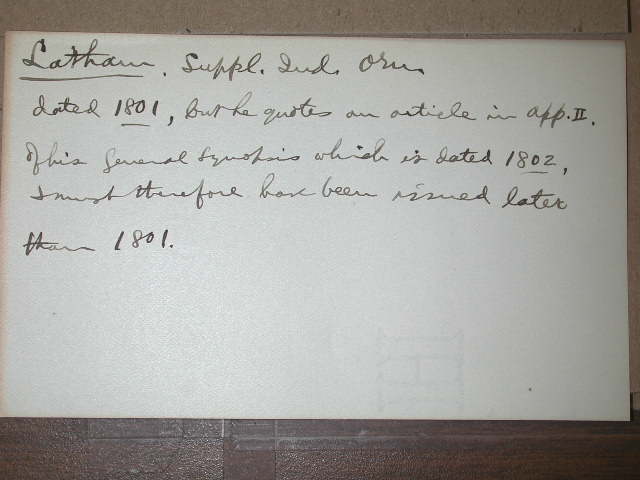
Richmond's decision is thus based on the date 1802 in his copy of the General Supplement II.
- Kirke and Swann ("A Bibliography of British Ornithology" 1917 p.341) in a footnote comment to
their dating of 1802 state:
Some copies are dated 1801, the second "I" in title date having apparently been
inserted after it was printed.
- Whittell ("The Literature of Australian Birds" 1954 p.411) wrote regarding the date of the General Supplement II:
Some copies have been met with bearing the date 1802, so there were,
apparently, two issues.
- Zimmer ("Catalogue of the Edwrard A.Ayer Ornithological Library" 1926 p.375) dates the work "1801?".
- Browning and Monroe ("Clarifications and corrections of the dates of issue of some publications containing descriptions of North American birds." 1991) p.385-386 discuss this matter and
resolve that 1802 is the appropriate date. They base this date on the fact that
1802 is the first time the work can be demonstrated to exist as a published work, because
this was when Latham presented a copy to the Royal Society. He had been elected to the
Royal Society 30 April 1801, but did not present the work to the Society until 1 April 1802.
I believe Browning and Monroe were correct about the date of presentation to the
Society, but wrong about the date of Latham's election to Fellowship in the Society.
This is understandable, as there were two John Latham, M.D.'s and both were
members of the Royal Society and the Linnean Society. The John Latham in question here
was elected in 1775. The two John Lathams are detailed by the Society as follows:
(from the Royal Society Online Archives accessed 2010.11.27)
	John Latham 1740-1837
AuthorizedFormsOfName 	Latham; John (1740 - 1837)
Surname 	Latham
Forenames 	John
DatesOfExistence 1740 - 1837
Nationality British
DatesAndPlaces
	Birth: Eltham, Kent, England (27 June 1740)
	Death: 04 February 1837
	Burial: Abbey church of Romsey, Hampshire
Activity
	Education: MD (Erlangen)
	Career: Studied anatomy under John Hunter;
		set up practice in Dartford;
		helped found the Linnean Society
Memberships:
	FSA (1774)
RSActivity
	Membership: Fellow
	Election Date: 25/05/1775
Relationships
	Father-in-law of George Ormerod (FRS 1819); grandfather of Edward Latham Ormerod (FRS 1870)
Source 	Sources: Bulloch's Roll; DNB
Obituaries: Proc Roy Soc 1837 No 30 p 12
Code 	NA2599
	John Latham 1761-1843
AuthorizedFormsOfName 	Latham; John (1761 - 1843)
Surname 	Latham
Forenames 	John
DatesOfExistence 1761 - 1843
Nationality British
DatesAndPlaces
	Birth: Gawsworth, Cheshire, England (29 December 1761)
	Death: Bradwall Hall, Cheshire (20 April 1843)
Address 	Bedford Row, London; Harley Street, London
Activity
	Profession: Physician
	Education: Brasenose College, Oxford. AB (1782); AM (1784); MB (1786); MD (1788)
	Career: Practised in Manchester (1784);
		Physician to the Radcliffe Infirmary, Oxford (1787); moved to London (1788);
		Physician, Middlesex Hospital (1789);
		Physician, St Bartholomew's Hospital, London (1793)
Memberships:
	FCP (1789); FLS
RSActivity
	Membership: Fellow
	Election Date: 30/04/1801
Source 	Sources:
Bulloch's Roll; DNB
Obituaries: Proc Roy Soc 1843 No 58 pp 485-486
Code 	NA3209
It is somewhat confusing that the Royal Society data shows the first Latham as having
helped found the Linnean Society (which he did) but does not show him as a Fellow of the
Society (FLS), which he was.
Schodde R, Dickinson EC, Steinheimer FD & Bock WJ. 2010. "The Date of Latham's
Supplementum Indicis Ornithologici 1801 or 1802?"
South Australian Ornitholgist 35(8):232-235 address the issue again.
Most directly they address Browning and Monroe's treatment and indicate that
Their [Browning and Monroe's] reasoning came from three coincident circumstances surrounding the release of the
English Supplement II.
These are:
- The presence of page and species number references in the Latin Supplementum to names in the English General Supplement II with the implication that the type for
Latin Supplementum could not "have been type-set until page
proofs of the English Supplement II were available."
- 250 copies of the English Supplement II were released (instead of
the 500 that Latham had exepcted) and this was "indicative of a single issue".
- The work was first demonstrated in existence in 1 April 1802 when it was
presented to the Royal and Linnean Societies.
I have some comments on this interpretation of Browning and Monroe.
- I don't see these as "coincident" as they did not all occur at the same time,
but that is unimportant.
- Browning and Monroe do not explicitly state that anything was "indicative
of a single issue". What they say is:
Whittell (1954) suggested that there were two "issues." Nowever, only 250 of the scheduled 500 copies
of Supplement II were printed, and these were the property of the publisher
(Latham, 1821:vi).
(For Whittell's statement see above).
I find this statement by Browning and Monroe to be less explicit than
might be hoped for. They certainly seem to imply (quite strongly) that there
was a single "issue" but don't make it clear how they think the reduced
number of copies (250 instead of 500) supports a conclusion of a single state of
issue, which again they imply but do not explicitly state. In my view,
the number of "issues" remains indeterminate. (See below for a discussion
of states or variants versus "issues").
Schodde et al. report finding that the
General Synopsis II occurs in three distinct date states:
- some with a printed Roman Numeral date of MDCCCI (1801)
- some with a printed Roman Numeral date of MDCCCI and with a hand addition of a "I"
to make it MDCCCII (1802)
- some with a printed Roman Numeral date of MDCCCII (1802).
There appear to be two plate states on the title page:
- some with a colored figure of the Maned Duck (Chenonetta jubata)
- some with a black and white figure of the Maned Duck (Chenonetta jubata)
In the copies Schodde et al. examined
it appears that the colored plate is found only in those with a printed date of 1801 or
a date hand corrected to 1802.
To quote Schodde et al. (p.233)
"copies (5) of the English Supplement II printed with the date of 1801 or corrected by
hand to 1802 bear a coloured figure of the Maned Duck (Chenonetta jubata) on the title
page, whereas in those with a printed date of 1802 (2), the figure is in black and white."
Thus I was a bit puzzled by the image below, and presumed that it was a black and white pdf in which the color does not show (http://www.biodiversitylibrary.org/item/85230#6)
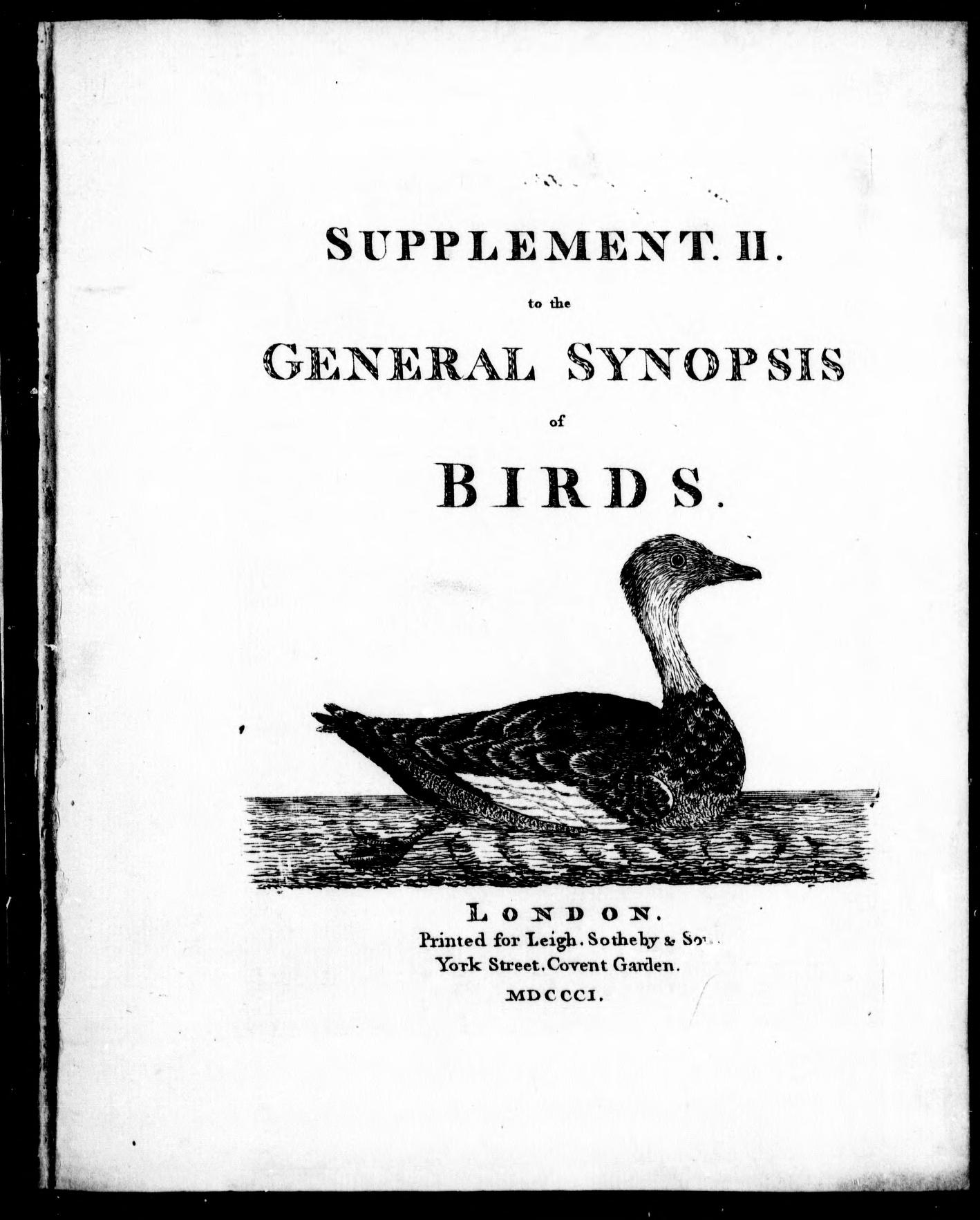 I emailed the Alberta Library to determine the nature of this image.
I was informed that the microform copy they have was prepared at the University of British Columbia.
Inquiry of the UBC Library indicates that the microform copy was prepared from a copy in their holdings.
This matter was investigated by the helpful people at the UBC Library. Katherine Miller there reports (2010.08.17) that
I emailed the Alberta Library to determine the nature of this image.
I was informed that the microform copy they have was prepared at the University of British Columbia.
Inquiry of the UBC Library indicates that the microform copy was prepared from a copy in their holdings.
This matter was investigated by the helpful people at the UBC Library. Katherine Miller there reports (2010.08.17) that
I checked our print copy of the Latham's General Supplement II.
I would like to confirm it's states: 1801 (in Roman numerals).
The plate is in black and white. Also, the paper has a bluish tinge.
So clearly this represents yet another state, different from those described by
Schodde et al., as this
example has an 1801 date and an uncolored title page plate.
(See below for possibly more important variant "states" undiscussed by any of
the authors above except Richmond). The only implication evident to me from this
is that a bewildering number of states of this publication exist, and we can
only speculate on what implications flow from that fact.
Principles of the Code
[2010.07.17] Before further addressing the complexities of this matter it is helpful
first to have in mind the approach required by the Code.
The relevant portions of the Code are these:
21.2. Date specified. The date of publication specified in a work is to
	be adopted as correct in the absence of evidence to the contrary.
- [21.3 deals with determining day, or month of publication,
and does not concern us here.]
21.4. Date incorrect. If the date of publication specified in a work is
	found to be incorrect, the earliest day on which the work is
	demonstrated to be in existence as a published work is to be
	adopted. In the absence of evidence as to day,
	the provisions of Article 21.3 apply.
[The Code treatment appears to take the position that dates are either correct or incorrect,
I presume "uncertain" is tantamount to incorrect, but all may not agree with this.
Certainly the Code implies that some action must be taken in the presence
"of evidence to the contrary." The Code does not indicate a course of action to take
if a work has multiple dates specified
(as is the case here). It would seem that both dates can not be "correct",
suggesting to me that
one date is certainly incorrect, but we don't know which one.]
I interpret the underlying logic as follows:
- Use the imprint date unless there is evidence to the contrary (21.2). (Note
that there is no qualification about the strength of the evidence which is unfortunate).
- If there is evidence to the contrary, use the date when the work
is demonstrated to be in existence as a published work (21.4).
It does not say: "Use the date specified in the absence of evidence to the
contrary, but if there is only weak evidence to the contrary,
then come up with a speculative scenario that you favor and that you think is probable
and use the date implied by your speculations."
I do think it is appropriate to take an approach which says in the face of uncertainty, do not rely
on speculation and imagination, but use established facts.
Schodde et al. address this problem somewhat differently, they state:
Article 21.2 of the International Code of Zoological Nomenclature, hereafter the Code
(ICZN 1999), governs the specification of dates of publication as follows: the date of publication
specified in a work is to be adopted as correct in the absence of evidence to the contrary.
The French text of this article, equivalent in force (Article 86.2 of the Code),
is even clearer and stronger, with 'evidence' replaced by 'preuve' = proof.
The date specified on the title page of the Latin Supplementum is 1801, without any exception
and variation whatsoever; and in the context of Art. 21.2 of the Code,
evidence for 1802 is presently much too circumstantial and open to question to displace it.
Corroborating the view from the Commission, the SCON accordingly recommends use of
1801 as the date of publication of the Latin Supplementum unless or until much firmer
evidence for 1802 is found.
- I wonder if "preuve" really replaces "evidence"? I would have stated
that it was in the place of it.
Certainly a "picky" point, but "replace" suggests an active substitution of
one for the other, which may in fact have happened., However,
The Code Preface (p.XVI) indicates at least some of the French text composition
preceeded the English text, and the French text "proved of major importance for the
development of the English text", so perhaps "evidence" replaces "preuve"?
- In their interpretation, Schodde et al. feel that the approach is to read the
texts in conjunction (Schodde in litt.), with the result that the evidence be
conclusive to the point of proof. I interpret this to mean that the French text
trumps the English text further implying that they are not of equal force,
so perhaps I do not understand Schodde's point.
A requirement that the English text be read in conjunction or "combination"
(see also Schodde et al. 2007. BBOC 127(4):273)
with the French text would not seem to me to be concordant with the "equivalent
force, meaning and authority" relationship established in the Code itself (Art.
86.2).
States, variants, and "issues"
These bibliographic technical terms are often confusing; a consideration of these matters is
most useful if the definitions are explicated.
Definitions of "issue"
- An Issue is the whole number of copies of a form of an edition put on sale
at any time or times as a consciously planned printed unit and varying only in relation to the form
of an 'ideal copy' of this unit. The criteria are that the book must differ in some typographical way
from copies of the edition first put on the market, yet be composed largely of sheets deriving
from the original setting; and that the copies forming another issue must be a purposeful publishing unit
removed from the original issue either in form (separate issue) or in time (reissue).
(emphasis added)
"Principals of Bibliographic Description", Bowers F, Russell & Russell, NY. 1962 p.40
An issue is all the copies of that part of an edition which is identifiable as
a consciously planned printed unit distinct from the basic form of the ideal copy.
"A New Introduction to Bibliography" Gaskell P, Oak Knoll Press, New Castle, Delaware 1972 p.315
When alterations, corrections, additions or excisions are effected in a book during
the process of manufacture, so that copies exhibiting variations go on sale on publication
day indiscriminantly, these variant copies are conveniently classified as belonging to different
states of the edition. ... When similar variations can be clearly shown to have
originated in some action taken after the book was published, two (or more) issues are
distinguishable.
"ABC for Book Collectors", Carter J, Alfred A Knopf, 5th ed., Revised.
1987 p.121-122
Carter goes on to say (p.122)
Yet in fact the onus of proof that an observed variation derives from a deliberate action taken after
publication lies, or should lie, like an iron weight on the conscience of anyone who begins to write the word issue.
It is a salutary, if rather too sweeping, preposition that all variants of this kind should be called states until
they have been proved otherwise -- or simply left as VARIANTS.
Schodde R, Dickinson EC, Steinheimer FD & Bock WJ. 2010. "The Date of Latham's
Supplementum Indicis Ornithologici 1801 or 1802?"
South Australian Ornitholgist 35(8):232-235 demonstrate (as others have) that the
General Supplement II exists in more than one state, though "state" is not a term they use.
They provide evidence of at least three variants (or states), and discuss some, but not all
of the variant states that are known to exist.
They also appear to assume that these different variant states constitute different
"issues" (p.233), though the basis for this assumption is not discussed.
Assuming that a "state" or "variant" is equivalent to an "issue" is a simple, but profound error. The presence of "at least two issues"
(p.233) appears to be central to their argument, as they state that the
presence of multiple issues
breaks the nexus between the Latin Supplementum and a single issue of the English Supplement II.
Establishing multiple "issues" (according to the bibliographic definitions above) requires either
determining the initial date of publication (an end toward which this exercise is directed) or
establishing what Leigh, Sotheby & Son saw as constituting a "planned printed unit".
As far as I can tell none of these have been done, so it appears to me that the presence of
"issues" in this matter remains for the moment entirely speculative.
Also note that they imply three different states for the General Synopsis, but mention only "at least two issues" (p.233).
I am confused by the use of "issue" made by Schodde et al..
Schodde et al. also emphasize important information revealed in a
footnote in Latham's 1821 "A General History of Birds". The text there reads:
	*A little time prior to the publication of the Second Supplement, on finding it very
	inconvenient to confer with my Booksellers so often as I had been accustomed to do, from the
	great distance I then lived from London, I agreed to put the remaining copies of the Seven
	Volumes, then published, into their hands, at a fair valuation; and finding it to be their wish
	that I should form an Eighth Volume, from the additional material I had collected since the
	publication of my first Supplement, I furnished it to them, to be printed at their own cost;
	but not long after, I learned, to my surprise, that instead of 500, the number of copies
	printed of the former Volumes, only 250 were struck off. What end this was to answer was
	known only to themselves, and I think it right to mention the circumstance here, to exculpate
	myself from the blame which has attached to me on that procedure, and which from that
	Volume not being then my property, it was not in my power to prevent.
and can be examined here:
Latham 1821 p.vi.
The footnote indicates that control (printing, production, and release to the public
[i.e. publication]) were entirely under Leigh, Sotheby & Son's control.
Latham also indicates that the publishers responded to forces unknown to Latham and
resulting in an outcome that was surprising and disappointing to him (producing only
250 rather than 500 copies). Their actions were unkown to Latham and surprised him when he
learned of them. Now, over two centuries later, our
knowledge of what occured, why, and when is necessarily uncertain.
The relation between Latham and the firm of Leigh, Sotheby & Son seems peculiar.
Leigh, Sotheby and Son published almost nothing but Auction Catalogues at this time.
The fact that John Latham was John Sotheby's cousin (ref. Herrmann F. 1981 "Sotheby's
Portrait of an Auction House". WW Norton & Co. p.14) may possibly have played a role
in their decision to continue publishing Latham's material.
Schodde et al. correctly indicate that "the London publisher (Leigh, Sotheby & Son) managed and distributed both" Supplements...
"and was free to issue them at any time once they were printed" (p.233).
However, the time of issuance is speculative,
they were equally free to delay issuance if they felt there were other matters of greater priority.
Presumably this was not the only work Leigh, Sotheby & Son managed at this time
and other considerations could easily have been factors in the timing of the distribution of the material.
Imaginative speculation can come up with a host of scenarios, many of which would posit issueance in 1801, and many of which could produce a delay into 1802.
I wondered what taxa might be affected by dating this work to 1801 or 1802.
The Richmond Index notes that the genus group Menura appears to have been a late addition to the work.
Richmond does not indicate how he knows this,
but it appears that the nature of the material supports his assertion. Thanks to Daria Wingreen-Mason's expert examination
of the two copies in the Cullman library, we know that Menura occurs on the asterisked single leaf with signature "Mm5" (pages 271* 272*).
Wingreen-Mason indicates that asterisks were used to indicate "bis" and these pages follow directly after
unasterisked pages of the same numbering.
The unique text shows that the pages are not cancellans, and their nature as an "addition" is further
supported by the fact they are a single leaf signature.
The potential that this single leaf may be a possible clue to the dating problem flows from the fact that precedence for the name Menura may be contested
between Latham and Davies. This matter is not discussed by Schodde et al..
The details of that matter I understand as follows:
- Major-General Thomas Davies presented a description of the genus Menura and described Menura superba. this was read November 4, 1800, and
published in volume VI of the Transactions of the Linnean Society of London 24 May to 27 May 1802. In this paper he refers to a speciemn sent to Lady Mary Howe as a gift,
as well as two specimens in the possession of Sir Joseph Banks, that were apparently subsequently depositied in the British Museum. [Lady Mary Howe, was
Lord Howe's wife, Lord Howe is known (among other things) for his defeat of the French Admiral Villaret-Joyeuse in the Battle of the Glorious First of June, 1794,
the first major naval battle in the war with revolutionary France. He (Richard) is also the brother of Lord William Howe, whose tactical and strategic decisions
enabled British defeat in the American Revolutionary War.]
The paper that Davies read on 4 November is appended by an expanded written description from additional specimens.
This expanded description is dated 19 June 1801. Whether or not Latham was aware of the paper as read, or the material
to be published is currently unknown to me. Davies (understandably) makes no mention of Latham, and Latham makes no mention of Davies, the paper he read,
or the publication by the Linnean Society.
- Latham is slightly less helpful regarding the provenance of his specimens. I do not recognize any specimen-source information in the Latin Supplementum; the English
General Supplement II gives no provinance for the main specimen described, but he does refer to a specimen in the British Museum (? possible one of the Banks specimens?),
and two specimens from "Mr Thompson of Saint Martin's Lane".
Thus, if a date later than late May is established for Latham's Latin Supplement, priority for the name
Menura would go to Davies, but Latham's presentation of a copy to the Royal Society on 1 April 1802 eliminates this possibility. Schodde et al. discussed the problem of the possibility
of Davies' name having priority (2007. BBOC 127(4):273) but dismissed the the problem
based on their interpretation that 1801 was the date of publication for Latham's work.
In my view, even if 1802 is accepted as the date of publication for Latham's use of the name
the date of March or April still preceeds the established date for the Davies publication.
We can only speculate on the implications that may be attached to the apparent
reduction of the production run to 250 copies rather than the 500 Latham expected. These speculations
are limited only by one's imagination.
Schodde et al. state (p.233) [the presence of multiple states of
the English Supplementum II] is evidence that there were at least two issues
of that work, so breaking the nexus between the Latin Supplementum and a single
issue of the English Supplement II (emphasis added).
It does not seem to me that the number of issues of this work has been established,
and I believe no useful discussion of this is presented by Schodde et al., and indeed I am not
sure what their definition of "issue" is. There is nothing to
prevent different "states" of a work from being issued at the same time. Again, it must
be emphasized that Latham's own subsequent (1821) evidence indicates that
Leigh, Sotheby & Sons were free to produce and issue the material in any manner they
saw fit.
The Code does not currently propose that contested considerations of dating be
resolved by a competition between speculative scenarios. Schodde et al.
present only one possible scenario, but many others are similarly possible.
It is not improbable that with multiple changes, and with other additional
considerations not relating to this work, Leigh, Sotheby & Son may have delayed release to the public (i.e.
publication) of the material until these considerations were resolved. We don't
know if this publication had a high priority, or a low priority for Leigh, Sotheby & Son.
It is reasonable to speculate that due to their ownership of the material they felt free
to deal with it in a manner commensurate with all of their priorities and consisderations.
They do not appear to have expected much in the way of sales for the work (as evidenced
by cutting the production run in half from its companion works).
It appears they felt they were released from satisfying Latham's expectations, and
could deal with the matter at their convenience. They owned the material and we must expect
that it was dealt with in a manner commensurate with all the priorities of the firm. I also
speculate that concerns over publishing priority (which we are
so concerned with) may not have concerned them at all.
The tantalizing possibility of resolving all this by recovering records from the firm
of Leigh, Sotheby & Son (now Sotheby's) would appear to be prevented by the tragic fact of the
fire on 29 June, 1865 that gutted Sotheby's and destroyed most of their stock and buisness records.
(ref. Herrmann F. 1981 "Sotheby's Portrait of an Auction House". WW Norton & Co. p.55).
Schodde et al. state quite explicitly that there is "evidence for 1802" (p.233) but
move to dismiss it on the grounds that it is "too circumstantial and open to question" --
no such qualifying language or rationale is expressed in the Code.
Schodde et al. also comment that the French and English texts have "equivalent force"
(p.233) quoting the Code Art. 86.2. I interpret this to mean that one can not say the French text (using the word "prueve") is
any more or less "correct" than the English text (using the word "evidence"). Certainly it is
not currently "proven" that the date 1801 is incorrect, and therefore since the English text has
"equal force" we must then ask is there "evidence" that it is incorrect. Schodde et al.
state, as indicated, that there is. It then seems to me that the appropriate course is to proceed
on the basis of Article 21.4, and we know that this was in existence as a published work
in April of 1802, with the delivery of the work to the Royal Society.
In passing it is interesting to note that the French heading of Article 21.4 is
"Date inexacte". It is a mistake (and an understandable one) to think that
when the French say "inexacte" they mean "inexact". My petite LaRousse (1963) p.548 defines
INEXACTE as "Qui contient des erreurs; faux" which I interpret as: "containing errors; false",
indeed, what we think of as "incorrect" (as used in the English version of 21.4).
The Latin "exacte", of course means "precise, accurate",
more in-line with English use. "Correct" in the LaRousse is defined as
"conforme aux règles" (conforming to the rule). It seems to me that in these senses
"inextacte" is more appropriate than "incorrecte".
I consider this to be an interesting and challenging case, and one which is not well served by
the language of the Code as currently constituted. I say this because there is still
"evidence" against accepting 1801, and the first demonstration "of its existence as a
published work" (the language of Art. 21.4) is apparently in April of 1802, when a copy was
presented to the Royal Society.
Schodde et al. emphasize the existence of different "states" of the English
Supplement II (which they call "issues" and which have attendant potential
implications for the dating of the Latin Supplementum).
Perhaps it is appropriate to treat "states" the way the Code treats "parts", but if this is made
explicit, I don't find it.
Additional points regarding Schodde et al.
- On p. 231 they state:
	These same species were published concurrently
	in vernacular English in the Supplement.
Given that the dates and nature of publication are in question, can it be
stated that they were published "concurrently?
then treat it as an established fact. In addition this idea of "concurrent"
publication would seem to contrast with their statement (p.233)
that there were at least two issues of that work,
	thus breaking the nexus between the Latin Supplementum and a single issue of the
	English Supplement II supposedly no later than 1 April 1802.
On the one hand they are state they are "published concurrently" but on the other
hand hold that the "nexus" between them is broken. Which is it?
- Schodde et al. offer no alternative possibilities to the one that they present.
Though many others are possible. Perhaps Leigh, Sotheby & Son held this as a job of
very low priority, and with the evidence of ongoing changes and modifications of the work
held back all copies. Possibly they only released material when Latham himself asked for
copies to be given to the Royal Society and the Linnean Society and they gave him
copies and then modified the subsequent copies to comply with the date and the
content changes that had been supplied. Speculation such as these are limited only
by imagination.
- Schodde et al. discuss the reasoning that Browning and Monroe (1991) used in
coming to their decision that 1802 was correct, but then Schodde et al.
supply their own reasoning for that of Browning and Monroe.
For example, Browning and Monroe make no mention of "page proofs",
though Schodde et al. imply that
Browning and Monroe felt that the Latin Supplementum "could not have been
type-set until page proofs of the English Supplement II were available."
There is an additional, and in my view more important, variant "state" of this work
The Richmond index mentions a page that is an apparent "late addition" to the work;
the page where the genus Menura is described. In support of the
possibility that this was a "late addition" to the work is the fact that it is a single leaf
signature "Mm5" and with pagination "271*, 272*". It is found immediately following pp.271,272 which is part of signature "Mm2" and is followed by signature "Nn".
Note that the signature progression is generally ... Ii Ii2 Kk Kk2 Ll Ll2 &c
in this portion of the work. "5" is a distinctly unusual suffix. Some letters,
J in this case, and often I, U, V, or W are often omitted, a convention continued from
the manuscript period.
This added single leaf signature is noted in Zimmer, but other than Richmond no one else seems
to have noted it, commented on it, or considered if it has implications regarding the history
of publication.
To date it appears to be present in most copies of the work. However the copy owned by
Dr David Donsker lacks this 271*, 272* leaf. The existence of this volume (with a
colored title page plate, and an imprint date of 1801) appears to me
to be stronger evidence for the possibility of a pre-1802 issue than the evidence suggested
by Schodded et al.. Stronger evidence but still speculative at this point, it seems to me.
[2010.11.25; 2011.01.29]
Additional facts developed in this matter:
- With the help of Laurel Peterson (my daughter) I searched the British Newspapers from 1800 to 1803 using the text strings
"Latham" and "birds" (case insensitive), using the Online 19th Century British Library Newspaper Print Data.
This resulted in 40 "hits", which we reviewed.
During this period the very first mention of the General Synopsis is found in
the March 29, 1802 issue of The Morning Post and Gazateer (Issue 10445, unpaginated)
it reads:
~~~~~~~~~~~~~~~~~~~~~~~~~~~~~~~~~~~~~~~~~~~~~~~~~~~~~~~~~~~~~~
LATHAM'S GENERAL SYNOPSIS OF BIRDS.
This Day is published, in One Volume, Quarto, with
    Twenty-four elegant Coloured Plates, price 2l. 7s. 6d. in
boards.
SUPPLEMENT SECOND, or VOL. VIIIth.
        By JOHN LATHAM, M.D., S.R.S.
    Printed for Leigh, Sotheby, and Son, York-street, Co-
vent-garden.
    N.B. Any Gentleman possessing the former Volumes,
may have their Sets completed, by an early application.
~~~~~~~~~~~~~~~~~~~~~~~~~~~~~~~~~~~~~~~~~~~~~~~~~~~~~~~~~~~~~~
Again, it must be emphasized that this is the very first notice of publication
of this work we were able to find. And of interest this notice does not mention the
Latin Supplementum. Presumably this is an oversight, as we know that Latham presented a
copy to the Royal Society 3 days later that included the Latin Supplementum. But we thus infer,
rather than prove the existence of the Latin Supplementum as a published work on March 29.
- March 29, 1802 (given as "Sunday" by the Gale document, but given as a Monday by the perpetual calendars I have checked)
is the Monday immediately preceeding the Thursday when Latham presented a copy to the Royal Society (April 1).
This is the first, but not the only entry announcing this publication. For those who
are new to the study of advertisments in early 19th cent. British Newspapers, it should be emphasized that such
announcements are often repeated, and indeed, on August 5, 1802 is a similar announcemnt
The Morning Chronicle (London, England), Thursday, August 5, 1802; Issue 10362.
~~~~~~~~~~~~~~~~~~~~~~~~~~~~~~~~~~~~~~~~~~~~~~~~~~~~~~~~~~~~~~
LATHAM's GENERAL SYNOPSIS of BIRDS.
This Day is published, in One Vol, Quarto, with 24 elegant co-
	loured Plates, price 2l. 7s. 6d. bds
SUPPLEMENT SECOND: with INDEX OR-
  NITHOLOGICUS, Continued.
	By JOHN LATHAM, M.D. F.R.S.
 Printed for Leigh, Sotheby and Son, York ſtreet, Covent-
garden.		Of whom may be had,
 Latham's General Synopſis of Birds, in Eight Vols. in quarto,
complete, with 143 Plates, beautifully coloured, price 11l. 12s.
in boards.
  Latham's Index Ornithologicus, Two Vols. quarto, price 1l
1s. 6d. in boards.
~~~~~~~~~~~~~~~~~~~~~~~~~~~~~~~~~~~~~~~~~~~~~~~~~~~~~~~~~~~~~~
This notice explicitly mentions the Latin Index Ornithologicus, and of interest,
indicates that it is also available as a distinct 2 vol. work (separate from the General Synopsis).
On August 11, 1802 this is repeated.
The Morning Chronicle (London, England), Wednesday, August 11, 1802; Issue 10367.
~~~~~~~~~~~~~~~~~~~~~~~~~~~~~~~~~~~~~~~~~~~~~~~~~~~~~~~~~~~~~~
LATHAM's GENERAL SYNOPSIS of BIRDS.
This Day is published, in One Vol, Quarto, with 24 elegant co-
	loured Plates, price 2l. 7s. 6d. bds
SUPPLEMENT SECOND: with INDEX OR-
  NITHOLOGICUS, Continued.
	By JOHN LATHAM, M.D. F.R.S.
 Printed for Leigh, Sotheby and Son, York ſtreet, Covent-
garden.		Of whom may be had,
 Latham's General Synopſis of Birds, in Eight Vols. in quarto,
complete, with 143 Plates, beautifully coloured, price 11l. 12s.
in boards.
  Latham's Index Ornithologicus, Two Vols. quarto, price 1l
1s. 6d. in boards.
~~~~~~~~~~~~~~~~~~~~~~~~~~~~~~~~~~~~~~~~~~~~~~~~~~~~~~~~~~~~~~
Also of some interest, this work is first mentioned in the Critical Review or Annals of Literature vol.37 March
in 1803. (Articles IX,X,XI [three articles in one] pp.318-327).
There (p.319) it states:
	To the second Supplement, which is accompanied by a
Supplement to the Index, we now proceed.
This statement, and the later notices of publication suggest that the Latin Supplementum was
available either with the General Synopsis II, or separately. There is some uncertainty
as to whether it was a two volume set or one volume set, and there appears to be a
discrepancy regarding the price of the Latin Supplementum -- possibly a typographic error in
one case or the other.
No combination of searching with "Index", "Indicus", "Latham", "Ornithologicus" yeided any notices
of pubication earlier than those already found.
Additional notes regarding Leigh, Sotheby & Son
- Leigh, Sotheby & Son published (but did not print) this work.
I wished to learn something of their pattern of activity during this period, to try to understand what kind
of priority this publication had. Leigh, Sotheby & Son were primarily developing their auction/booksale
activities and there "publishing" activities were very minimal indeed. During the period 1800 to 1806, other than
an auction catalogue, I could find only one other work besides the Latham material that was "printed for Leigh, Sotheby & Son"
is "The Wiccamical chaplet", George Huddesford, ed. 1804.
- This suggests the possibility that for this busy firm, publishing was a very minor part of their buisness, and possibly
a low priority.
[BEGIN OLD NOTES]
- Conventionally cited in the literature as 1801, but interpreted
by Browning and Monroe, 1991 to be 1802. Which I followed until 2003.05.21. At which time
I felt the arguments of Murray Bruce (v.i.) were convincing, and that 1802 was speculative
without actual supporting evidence provided.
- Subsequently, upon examination of CW Richmond's unpublished notes on Dates of Publication
the following evidence came to my attention. Richmond has a handwritten card that presents the
following :
~~~~~~~~~~~~~~~~~~~~~~~~~~~~~~~~~~~~~~~~~~~~~~~~~~
Latham, Suppl. Ind. Orn.

dated 1801, But he quotes an article in App. II,
of his General Synopsis which is dated 1802,
it must therefore have been issued later than 1801.
~~~~~~~~~~~~~~~~~~~~~~~~~~~~~~~~~~~~~~~~~~~~~~~~~~~
- I have now (2004.02.24) examined the General Synopsis, and have a clearer understanding of the
problem, though at the moment a clear resolution is not evident. Similarly it appears I
will want to re-examine the work above. Initially I had interpreted the note to mean that
"he" (Latham) "quotes an article" (of the Suppl.Ind.Orn.) in the General Synopsis --
but this of course makes no sense with regard to fixing the date for the Suppl.Ind.Orn.
I now think the Richmond card means that within the Suppl.Ind.Orn. that Latham quotes an
article which is in his General Synopsis. Richmond's thinking then is that if the
General Synopsis is dated as published in 1802 (even though many copies bear
the imprint date of 1801), then it implies that the Suppl.Ind.Orn.
came out at the same time or later than the General Synopsis.
- I think this argument is not unreasonable, but there is the possibility, that as
Latham is the author of both works, he could possibly quote and article of his own, that
he had written but that had not yet been published.
- For the moment, I leave the confused and convuluted notes below I have
written on this subject.
The full facts of the publication history do not appear to be fully resolved with certainty,
but my current interpretation is as follows.
- It appears to be established with a high degree of certainty that
at least the English version of this work, was delayed in publication
until 1802. I believe it was the discovery of this delay, that prompted
Browning and Monroe to revise the date to 1802. Browning and Monroe noted
that "some copies of the work" are dated "MDCCCI" and some "MDCCCII" but
did not clearly distinguish between the Latin and English versions.
- The fact that the imprint date of the English version was modified to
reflect the delayed publication and that the imprint date of the Latin
version shows 1801 argues for its not having been delayed until 1802.
- If a Latin version of the work was shown have have an imprint date of
"MDCCCII" I would revert to the interpretation that 1802 would need to be followed for
all taxa cited from the work.
- Usually cited as 1801, but see Browning and Monroe, 1991.
"Clarifications and corrections of the dates of issue of some
publications containing descriptions of North American birds."
Archives of Natural History 18(3):385-386..
- The Handbook of Birds of the World, (at least in volumes 1-6)
continues to list the date as 1801.
- Murray Bruce offers strong arguments in favor of 1801.
(2001.05.11) which I include here:
[BEGIN M. BRUCE]
Latham 1801 vs 1802:
I agree with Browning & Monroe 1991 that the English version of
Latham's second supplement to his 'Synopsis' apparently was delayed
until 1802, but disagree that the Latin version was
"probably available that same year" (my italics).
Following Art. 21.2 of the Code, with reference to Art. 21.3,
the date of publication of the Latin version is specified in the
work as 1801 and can be dated to 31 Dec. 1801.
-
- [APP: ICZN "21.2 Date specified. The date of
publication specified in a work is to be adopted as correct in the
abscence of evidence to the contrary."]
- [APP: ICZN "21.3 Date incompletely specified. If
the day of publication is not specified in a work, the earliest day
on which the work is demonstrated to be in existence as a published
work is to be adopted as the date of publication, but in the
absence of such evidence the date to be adopted is
- 21.3.1 the last day of the month, when month and year, but not
day are specified or demonstrated, or
- 21.3.2 the last day of the year when only the year is specified
or demonstrated
]
There is no proof it came out in 1802, only proof indicating a
delayed publication of the English version.
As early as 1787 (introduction to the first supplement) Latham
was quite clear that Latin diagnoses of the birds described in his
English works needed to be published separately "to be of real
utility". His 1790 Index was the Latin version of his 'Synopsis'
and first supplement, plus some recent discoveries, notably from
Australia. The delayed publication meant Gmelin got the credit for
nearly all his new birds in the 'Synopsis'.
In the introduction to the 1790 Index Latham complained of what
Gmelin had done and it is apparent that he reluctantly accepted
most, but not all, of Gmelin's names. With increasing competition
from other publications, I hardly think Latham would allow himself
to have his names usurped a second time. Both versions of the
second supplement were clearly intended to be published in 1801 and
the easier to produce Latin version would have appeared first,
while the English version was delayed (most probably due to the
production and printing of plates). I think the English version was
the only one announced by the Royal Society because it was more
expensive to produce and the publishers were keen for a return on
their investment, and also because the source of the Latin names
came out after the Latin version.
The 1801 text is full of new discoveries from Australia, even
with competition from others, notably the works of George Shaw, and
delays could have cost Latham priority for some of them.
In my opinion, I don't understand how a date change has been
accepted without any proof to justify the change.
[END M. BRUCE]
- Additional thoughts from Murray Bruce (2003.05.17):
A paper I sought to use when working on the bird classification history
turned up too late.  This is W.L. Sclater's excellent little historical
overview of early African ornithology published in the Hartert Festschrift
(J. f. O. 1929).  In a concluding section on Latham he stated: "His first
work 'A General Synopsis' was issued in three volumes with two supplements
between 1781 and 1802" and a little later "In a second work 'Index
Ornithologicus' in two volumes published in 1790 with a supplement issued in
1801".  This distinction between the two is clearer in older sources and I
think the confusion for some has been because they were often bound together
and obviously connected by subject.
- Murray Bruce has continued to send additional arguments and indications in favor of 1801 contra
1802, and on long reflection I remain undecided (2003.05.17). The ICZN Code certainly does
not seem to settle the case. A literal reading of the Code would suggest that any evidence against
the specified publication date, would render that date invalid irrespective of the quality or character of
the evidence.
- As I see it, in the abscence of proof that both the Latin, and the English versions of the Supplement
were delayed until 1802, it is appropriate to defer to the imprint date of 1801.
The probability that both Latin and English versions were delayed until 1802, given only
that we know for sure that the English version was delayed, can not be established, and
the imprint date.
[END OLD NOTES]
- Of possible interest, but uncertain application in this issue comes the following understanding
from Gaskell P. 1995. "A New Introduction to Bibliography". Oak Knoll Press. Delaware.
on p.317-318 he notes.
'The Rule in general observed among Printers,' wrote Nichols concerning
eighteenth-century practice, 'is, that when a Book happens not to be
ready for publication before November, the date of the ensuing year is
used.'
ref. Nichols, J. Literary anecdotes, London 1812, iii, p. 249 n.
2003.05.21; 2003.10.13; 2004.02.05; 2011.01.29
Cercomacra
laeta
- Split from C. tyrannina by: Bierregaard, R.
O.,Jr., Cohn-Haft, M. and Stotz, D. F. (1997) "Cryptic
biodiversity: an overlooked species and new subspecies of antbird
(Aves: Formicariidae) with a revision of Cercomacra tyrannina in
northeastern South America." Orn.Monogr. 48: 111-128.
Scleroptila levalliantoides spelling
....; 2004.04.18; 2010.01.08; 2010.07.11.2013.04.06
Laniocera
1841
- Peters, Sherborn, and Richmond, et al. 1992 list this as
1840.
- However {Richmond, et al. 1992} card for [Haematornis] luteolus
which is published on p.354 notes "Publ. in 1841". So I interpret
this date as 1841 as well.
- Shulze et al. Band 3 lief. 13 p.1764 lists the date for this
taxon as "1840 [1841]", indicating an imprint date of 1840 and a publication date of
1841.
....; 2004.10.02
Lipaugus
lanioides Citation
- Peters Checklist 8:296 lists this as "p.156".
- {Richmond, et al.} indicates it is col.156.
Larosterna
1852
- Peters Checklist 2:344 gives 1849 as it is usually
cited.
- Mathews, 1925 demonstrates this is 1852.
Columba larvata
1809
- Peters Checklist 3:121 lists 1810.
- See {Browning and Monroe, 1991}.
Chlamydera lauterbachi citation
- Reichenow's name is usually not enclosed with parentheses (see
Peters Checklist 15:181) but this was originally placed in
Chlamydodera.
- Chlamydodera however, appears to be an emendation of
Chlamydera Gould, which is Gould's emendation of
Calodera Gould (preoccupied).
- However, the issue is (in my mind) still in question, as:
- The portion of Birds of Australia where Gould erects his
emendation "Chlamydera" is (according to the Richmond Index)
"suppressed".
- There is a Chlamydodera in Agassiz's Nomen. Zool.
Index 1846, which is an emendation pro Gould's
Chlamydera.
Brachypteryx
leucophrys
- Peters Checklist 10:16 (Ripley) has "leucophrys Temminck,
1827, Pl.Col., livr. 76 pl.448, fig.1". But as Dickinson points out, the
same plate is refered to as livr.75 by Deignan in the same volume
on pp.293,309
- {Richmond, et al. 1992}, and {Sherborn, 1902} indicate the name
is "leucophris".
- {Richmond, et al., 1992} show livr.74.
- {Sherborn, 1902} has a note "(74,? err. pro 75)".
- Dickinson EC (2001) discusses this, and would appear to resolve the
issue, demonstrating that the "74" is most likely a misprint for
75.
- Livraison 75 makes the date 1828 rather than 1827.
- Dickinson EC. 2001. 'Systematic notes on Asian birds. 9.
The "Nouveau recueil de planches coloriees" of Temminck &
Laugier (1820-1839)' Zool. Verh., Leiden 335 p.52-53'
2003.03.07
Dendrocopos
leucopterus 1871
- Peters Checklist 6:187 gives 1870.
- {Richmond, et al. 1992} gives 1871, indicating it was published
15 Jan.
- HBW 7:486 (Short & Horne) give 1870, evidently
following the Peters Checklist.
Furnarius
leucopus Citation
- Peters Checklist 7:70 does not include the figure and
number information, which I take from {Richmond, et al. 1992}.
Coracina
leucopygia 1850
- Peters Checklist 9:179 has 1851.
- See {Browning and Monroe, 1991}.
Turdoides
leucopygius 1837
- Peters Checklist 10:344 has 1840.
- See {Zimmer, 1926}.
Rallina
leucospila 1876
- Peters Checklist 2:173 has 1875.
- See {Poggi R, 1996}.
Rhagologus
leucostigma 1876
- Peters Checklist 12:7 has 1875.
- See {Poggi R, 1996.}
Dendrocopos
leucotos 1802
- Uncertainty remains regarding the publishing history of this
work.
- Peters Checklist 6:189 has 1803.
- {Richmond, et al. 1992} lists this taxon as published in
1802
- Mathews lists all of Vol.1 as 1802
- {Zimmer, 1926} indicates that at least some of Vol. 1 was
published in 1802.
- HBW 7:483 (Short & Horne) give "1803", and in this
they most probably are simply following Peters Checklist.
2002.06.29
Clamator
levaillantii
- Not in Peters Checklist Vol. 4.
- Often placed in Oxylophus.
- Dr R.B. Payne in HBW vol.4 does not recognize
Oxylyphus.
Garrulus lidthi
1850
- Peters Checklist 15:235 has 1851.
- See {Browning and Monroe, 1991}.
Bartramia
longicuada citation (plate)
- The Peters Checklist 2:259 does not include reference to
the plate.
Falco
longipennis 1838
- The Peters Checklist 1:417 has 1837, which agrees with
Sherborn.
- However {Richmond, et al. 1992} indicates a date of Jan.1 1838,
which I follow here.
Lophotibis
Citation
- Peters Checklist 1:262 gives a different title for the
source.
- H&M 3rd:83 cites this to 1853, but cites another genus
(Nipponia) on the preceeding page of H&M (p.82) and from the very same
page of Reichenbach's work to 1850(!).
- I follow {Browning and Monroe, 1991}, and Zimmer, and other authors who
recognize that lifr. 3 of this work (containing the names) was issued in 1853.
Ornisyma lumachella = Augastes lumachella 1839
- Peters Checklist 5:126 has 1838.
- {Richmond, et al. 1992} has "publ. 1839".
- This occurs in no.12 (for Dec. 1838). Regarding the December numbers of the
Rev.Zool. it is certain that some of these were not published until the year
following the imprint date, and it is possible that the December numbers were
never published in the imprint year.
....; 2004.10.15
Gorsachius
leuconotus Citation
- Peters Checklist 1:231 lists the page as 33
- It is species 33 and is on unnumbered page 189.
Caliechthrus leucolophus Citation
- Peters Checklist 4:35 includes only p.22.
- The additional page is referenced in {Richmond, et al.
1992}.
Lophotriccus 1884
- Peters Checklist 8:73 has 1883.
- This latter part of the Proceedings was not published until
1884 according to the Richmond Index, and also subsequently determined by Duncan.
- While other taxa from this part of the PZS have been corrected from 1883 to 1884
in the H&M 3rd Corrigenda 2.1 (e.g. Carduelis siemiradzkii H&M
p.750), Lophotriccus is not corrected.
....; 2004.11.15
Amazilia luciae
1868
- Peters Checklist 5:64 has 1867, as do the AOU
Checklists.
- All pages of this volume of the Proceedings prior to p.113 were
published in 1867. Part 4 (p.113 to end) were recieved by the
Entomological Society of Philadelphia prior to May 11, 1868.
- Therefore I interpret 1868 to be the likely date, though 1867
is not impossible. (Part 3 was received by the Smithsonian
on Nov. 1, 1867.)
Sturnella (Pezites)
loyca
- Peters Checklist 14:176 conisders this to be synonymous
with militaris.
Thryothorus longirostris 1819
- Peters Checklist 9:415 has 1818.
- Vol.34 of this work was published in 1819, according to the
researches of Richmond and Sherborn.
Thescelocichla leucopleura Citation
- Peters Checklist 9:263 transposes the numbers in
indicating the page numbers ("p.238" for p.328), and lists the
publication year as 1856.
- Ms. Robin Sinn, librarian at the Philadelphia Academy has
confirmed for me the page number, and that this portion of Vol.7
was published and available in 1855.
Caracara
lutosa
- Not in Sibley and Monroe as a species.
- Listed in Peters Checklist Vol.1 as subsecies.
- See Dove and Banks. 1999. A Taxonomic study of the
Crested Caracaras. The Wilson Bullentin
111(3):330-339. for a discussion of Caracara
taxonomy, and the recommendation for elevation to species
status.
- Often misspelt C. lutosus (for example in AOU CL,
Dove & Banks, 1999 and HBW vol.2 p.250) However, corrected to
C. lutoa, in the supplement to the Checklist Auk
117(3).
Seicercus latouchei
- By one interpretation, this taxon is regarded as the same as
Seicercus soror Alstrom & Olsson 1999 Ibis 141 p.556-557.
- The publication Martens, Eck, Packert & Sun, 1999 Zool.
Abhandlungen Staatliches Mus. fur Tierkunde Dresden 50, 281-327 (
The Golden-spectacled Warbler Seicercus burkii - a species swarm
(Aves: Passeriformes: Sylviidae) Part 1). appeared several days
before that of Alstrom & Olsson and proposed at least 6 species
in the S. burkii complex (incl. S. soror):
distinctus, valentini, omeiensis, soror (under the name
"latouchei"),whistleri, burkii.
- However, the taxonomic and systematic considerations are not
equivalent between Martens, et al., and Alstrom and Olsson. Further
resolution of the issue may occur, but the most complete consideration
at this time (2000.10.07) is the letter to Ibis by Alstrom and Olsson
"Golden-spectacled Warbler Systematic" Ibis 2000.
142:495-500. They hold S. latouchei to be a
subspecies of S. valentini.
Colinus
leucopogon
- Treated as a full species by J.P. Carroll, in: Handbook
of the Birds of the World. Vol. 2, J. del Hoyo, A. Elliott & J.
Sargatal (eds.), Barcelona, 1994
Camptorhynchus
labradorious Extinct
- Extinct. The last known specimen of this species was taken on
December 12, 1878 in Elmira, New York.
Poecile lugubris
spelling
Pyrrhura lepida
Nomenclature/Systematics
- A confusing situation:
- The type of the name perlata is an immature of:
- making that name a junior synonym of P. perlata.
- The form previously known as P. perlata now becomes
P. lepida.
- Originally described by Wagler in Sittace
Augastes
lumachella Spelling
- Most often spelt "lumachellus".
- Prof. K. L. Schuchmann argues that the original spelling
"lumachella" "comes from Italian and thus [is] invariable in
scientific nomenclature." HBW 5:660.
Otus lettia Systematics
- Described in Scops
- Peters Checklist 4:98 has as a subspecies of Otus
bakkamoena
- Sibley & Monroe treat this as a "group".
- HBW 5:158 holds it to be a species, predominantly on the
basis of vocalizations.
Otus lempijii Systematics
- Originally described in Srix [sic].
- Held by Peters Checklist 4:99 to be a subsepcies of
O. bakkamoena.
- Held by Sibley & Monroe to be a species, then moved to
"group" status in the Supplement.
- Held by HBW 5:158 to be a full species, evidently
predominantly on the basis of vocalizations.
Thalassornis leconontus Spelling
- This taxon was spelt "leuconotus" by Eyton (who also is
the author of the genus).
- This spelling is correctly given in the HBW 1:577 in their
"taxonomy" listing.
- However, the name is spelt "leuconotos" two lines above this
in the species listing.
- The nominate subspecies is listed as T. l.
leuconotus.
- I do not find discussion of the spelling, or justification for
change in the text.
- The "Errata" (tipped in separate leaf, dated Barcelona, March
1993) discusses other issues on this page (p.577) but not this.
- I interpret this to be an editorial lapsus; if not it would
appear to me to be an unjustified emendation.
Lorius Nomenclature
- Previously listed as:
- However, the Vigors name is the officially listed name for the
Genus by the ICZN, the Boddaert name evidently suppressed in a 1970
decision. (ref. N.J. Collar in HBW 4:348).
Cacatua leadbeateri
Systematics
- Brown DM, Toft CA. 1999. Molecular systematics and
biogeography of the Cockatoos (PSITTACIFORMES: CACATUIDAE). AUK
116(1):141-157. argue that this perhaps should be
returned to the monospecific genus
-
Ducula lacernulata Date
- HBW 4:240 gives 1823.
- Zimmer indicates the date for this livraison is 1822.
Ducula luctuosa Date
- HBW 4:241 gives 1825.
- Zimmer indicates the date for this livraison is 1824.
Lonchura leucogastroides 1858
- Listed as 1856 by Peters Checklist 14:374.
- This is in the second volume of the work with an imprint date
of 1856. All the indications I find show that to have been
published in 1858, the date given by the Richmond Index and
Mathews' Bibliographic listing of this work (June 30, 1858).
- HBW and Peters usually list taxa from this volume as 1856 or
1857.
Botaurus lentiginosus a Author
- HBW 1:428 gives Montagu as the author of this taxon, as
does (I am told) the recent Heron Handbook.
- Montagu was given as the author by the AOU CL 4th ed. (1931), and
changed to Rackett in the AOU CL 5th ed. (1957), and has remained
so in subsequent editions.
- Peters 1(2):243 also lists Rackett.
- No mention of the issue of authorship is made in HBW.
- I presume that the AOU changed from Montagu to Rackett on the
basis of some positive information, and thus I follow the AOU here.
- Alan Knox; Historic Collections; University of Aberdeen King's College; Aberdeen
very helpfully provided more information on this (in litt. 2006.06.02).
Twenty-eighth Supplement to The American Ornithologists' Union Check-List of
North American Birds. Auk 70 (1953): 359-361.
Botaurus lentiginosus, formerly accepted as based on Ardea lentiginosa
Montagu, Suppl. Orn. Dict., 1813 (preface dated June), not paged, is now taken from
the earlier description by Rackett of the same specimen: Ardea lentiginosa,
in Pulteney, Cat. Birds, Shells, and some of the more rare Plants of Dorsetshire,
second edition (enlarged), May, 1813, p. 14. (Parish of Piddleton, Dorsetshire,
England.) The name will be cited as Botaurus lentiginosus (Rackett), with the
reference as given above. See Macdonald and Grant, Bull. Brit. Orn. Club, vol. 71,
no. 5, June 22, 1951, p. 30.
- In turn, Macdonald and Grant's 1951 paper shows that the problem turns upon
establishing priority for the two publications. Macdonald and Grant indicate that
internal evidence suggests Montagu's work has priority, other evidence suggests that
Rackett's work was published first.
- Rackett's work states (p.14)
Mr Montagu has obligingly communicated the
description of this new species.
and he refers to Monatgu's "Supplement"
- However, the fly leaf of the copy of Rackett's work that is held in the
library of the Linnean Society has an inscription in Rackett's handwriting,
dated "May 24th, 1813".
- The Introduction to Montagu's work is dated June 1813, so it appears
Rackett's work has priority.
....; 2006.06.02
Lymnocryptes Author Citation
- Authorship often attributed to Kaup. As in Peters (1940) 2:279 and
AOU CL 7th(1998):176.
- HBW 3:491 gives the Boie citation, as does Sherborn.
- The Archives of the Academy of Natural History in Philadelphia contain a letter from
CWR to Witmer Stone (1927.04.23) in which he points out that the Boie citation is earlier
than the Kaup.
- The Boie citation is listed in the 1931 AOU 4th Checklist (p.111). It is
of some interest that Peters cites Kaup, almost 9 years after the AOU CL, and makes no mention
of the Boie citation.
- The AOU CL 5th(1957):180 changes to the 1829 Boie citation without
comment, and this is continued in the AOU CL 6th(1983):204.
- Lymnocryptes does not seem to appear in the Cat.BirdsBrit.Mus. Presumably
the change in the AOU CL 4th resulted from following Peters
Checklist.
....;2005.04.23; 2006.05.27
Artamus leucoryn
Concept / name
- The specific epithet "leucorynchus" as it is
usually given would appear to be an unjustified emendation.
- The full and formatted text of the original description is:
"leucoryn. LANIUS niger, rostro pectore abdomine uropygioque
          albis.
        Lanius manillensis. Briss. av. 2. p. 180. t. 18. f. 2.
          Aub. misc. t. 9. f. 1.
        Habitat in Manillis.
        Cauda aequalis."
- See MantissaPlant. for a discussion of the
significance of the period following the specific epithet.
- Peters Checklist (Mayr) 15:161-3 has the following
(selected appropriate entries):
"Artamus leucorhynchus leucorhynchus (Linnaeus)
        Lanius leucoryn[chus] Linnaeus, 1771 ... .

        Artamus      leucoryn. macroterus Oberholser, 1932 ... .

?Artamus leucorhynchus amydrus Oberholser
        Artamus leucoryn amydrus Oberholser, 1917 ... .

Artamus leucorhynchus humei Stresemann
        Artamus leucorhynchos humei Stresemann, 1913 ... .

Artamus leucorhynchus celebensis Bruggermann
        Artamus leucorrhynchus (L.). var. celebensis Bruggermann, 1876 ...
... .
... .

Artamus leucorhynchus leucopygialis Gould
        ... .
        ... .
        Artamus leucorhynchus parvirostris Hartert, 1899 ... .
        Artamus leucorhynchus harterti Mathews, 1912 ... .
        Artamus leucorhynchus melvillensis Mathews, 1912 ... .

... .

Artamus leucorhynchus tenuis Mayr
        Artamus leucorhynchys tenuis Mayr, 1943 ... .

... ."
We have:
- leucoryn. Linnaeus 1771
- leucorrhynchus Bruggemann 1876
- leucorhynchus Hartert 1899
- leucorynchos Stresemann 1913
- leucoryn Oberholser 1917
- leucoryn. Oberholser 1932
- leucorhynchus Mayr 1943
- leucoryn[chus] Mayr (pro Linnaeus) 1962
- If the name "leucoryn" is interpreted as an abbreviation, or in
some way requiring completion then the rationale for that must be
given. It is not supportable on the basis of the period "."
at the end of the name in the original publication (see Mantissa
Plantarum details).
- If some some argument exits why Linnaeus intended a longer
name, there must be evidence why he had the extension "-chus"
rather than "-chos" in mind, and why he did not intend longer names
for others he published.
- However, the ICZN has held in Opinion 2455 that mascarinus is a valid emendation of "mascarin." as the name
was originally published.
2020.07.07
Lophornis Nomenclature
Normand David writes an explanatory note (2001.04.28):
Lophornis spelling
The Greek noun ornis [bird] is masculine as well as
feminine (Liddell & Scott 1996, Greek-English Lexicon).
Accordingly, names ending in -ornis do not end in a
transliterated Greek word of fixed gender (ICZN 1999, Art. 30.1.2),
but end in a word of common gender (ICZN 1999, Arts. 30.1,
30.1.4.2). ICZN (1999, Art. 30.1.2, Examples) stated that
"Ichthyornis, ending in -ornis (ornis), is
masculine", but examples "do not form part of the legislative text
of the Code" (ICZN 1999, Art. 89.2). Actually, Ichthyornis
Marsh, 1872, is masculine because it was established in
combination with dispar (a Latin adjective not indicative of
a particular gender) not because it ends in -ornis.
A name that is or ends in a Latin or Greek word of common gender
is feminine only when it is established in combination with one or
more feminine Latin or latinized adjectives; it must be treated as
masculine in all other situations (ICZN 1999, Arts. 30.1, and
30.1.4.2).
Indeed, Anthornis Gray, 1840, which was established in
combination with the feminine latinized adjectives melanura
and caeruleocephala, is presently treated as feminine (as
per Peters 1964, etc.), and Torreornis Barbour & Peters,
1927, which was established in combination with the feminine Latin
adjective inexpectata, is also treated as feminine (as per
AOU 1998, etc.).
Therefore:
Lophornis Lesson, 1829, was established without a name
in combination [Lesson listing seven species names in
combination with Ornismya], and is thus
MASCULINE.
Consequently HBW 5 has the correct spellings for the adjectival
names combined with Lophornis.
--------------------------------------------------
Normand David, Directeur general
Association quebecoise des groupes d'ornithologues
4545 Pierre-de-Coubertin
C. P. 1000, Succ. M
Montreal, Qc
H1V  3R2
Le Maout
Spelling
- N.J. Collar HBW 3:263 spells this man's name "Le
Mahout".
- I understand this man to be Emmanuel Le Maout [1800-1877].
- He is listed as "Le Maout" in the Catalogue of the Books of the
British Museum, and his name is spelt "Le Maout" on the title page
of works such as:
Le Maout, Emmanuel & Joseph Decaisne: Traité
général de botanique descriptive et analytique.
Première partie: abrégé d’organographie,
d’anatomie et de physiologie. Deuxième partie:
iconographie, description et histoire des familles. Paris, F.
Didot, 1868, 1. ed., pp. x, 746, 5500 engraved text-illustrations
by Louis Charles Auguste Steinheil and Alfred Riocreux, small folio
(217 x 314 mm).
- I agree with the suggestion that the spelling "Le
Mahout" most probably results from the inadvertant result of
"spell-checking".
2003.02.15
Poecilotriccus luluae
Concept
- Separated from its allospecies P. ruficeps on the basis
of facial markings, belly color, and song.
- Type Location: Peru, Departmento Amazonas, 3.5 road mi. (5.63
km) SE of Corosha. 6900 ft.
Corosha
Lipaugus
Spelling
- Originally spelt "Lipangus" by Boie.
- Peters Checklist 8:293 (Zimmer) includes a note
indicating
- 'The cited classical derivation,
"λιπαυγσς = splendore
deficiens," indicates a correctible error. -- J.T.Z.'
- The subject of "correctible errors" is not inappropriate here, as the
Greek orthography in this volume of Peters appears to have been a
challenge for the M.C.Z. press. Their rendering of the Greek appears
problematic on two accounts.
- The attempt at the Greek letter υ looks clearly like the
use of a lower case Gothic "u" to appear υ-like.
- Even accepting the attempt at rendering the upsilon, the word
appears to be spelled incorrectly -- as written it ends in two
sigma's, the usual sigma and the final sigma. The Greek word in fact
is λιπαυγης [=deserted
by light, dark, sunless; blind]
In the Richmond Index, this is rendered
λιπαυγος
- The Richmond index cites Cabanis Arch. fur Naturgesch. 1847
Band I p.233 (footnote) for the initial emendation.
- Normand David has investigated this matter further and writes (2005.12.09):
I had the opportunity to take a look at Boie 1828 (Isis, p. 318)

The original is Lipangus [sic], with a footnote that reads: "Lipangos, splendore
deficiens". Lipangos is written with Greek letters. The difference between "n" and "u" is slight
but visible. The Greek word "lipangos" does not exist, but there is the adjective lipanges
[dark, deserted by light; =the Latin splendore deficiens/lacking light].

Is the error correctible under 32.5.1? Meaning that we have an inadvertent error as indicated by
internal information in the OD. A purist would say that Lipauges should be the correct
form of the genus. Others would argue that Boie thought that lipaugos was the classical
Greek form, that he latinized correctly,  but inadvertently with "n" instead of "u" both in
Greek and in Latin.

One thing for sure, if the spelling Lipaugus is not accepted as a justified emendation of
"Lipangus", it is an unjustified emendation in prevailing usage.

Note that the name is cited Lipaugus Boie 1828 -not Lipaugus Cabanis 1847
(33.2.3)-; and now, under 33.2.3.1, when an unjustified emendation is in prevailing usage AND is
attributed to the original author and date, it is deemed to be a justified emendation!

Well, as far as I can SEE,  Lipaugus it is, no matter how!
ND
....;2004.04.18
Lipaugus
Citation
- Peters 8:293 (Zimmer) lists "p.318.
- This work is cited by columns; there are two per side of a
(physical) page.
Thanks to Colin Jones for picking this up.
Chiroxiphia
lanceolata Citation
- Peters 8:267 (Zimmer) lists "p.931.
- This work is cited by columns; there are two per side of a
(physical) page.
Thanks to Colin Jones for picking this up.
Laterallus
levraudi Date
- Peters Checklist 2:191 gives a date of 1868.
- HBW 3:157 (PB Taylor) gives a date of 1868.
- The Richmond Index gives a date of Apr. 1869.
- Duncan's 1937 listing of dates of Publication of the PZS gives
March 1869.
- I follow the Richmond Index and Duncan here.
Calonectris
leucomelas Date
- The date for this livraison is usually given as 1835 (e.g.
Peters Checklist 1:89, AOU CL 7th ed. p.17, HBW
1:251, Richmond Index, Sherborn)
- Dickinson EC (2001) points out that Mees (1994) provides
evidence to the contrary.
-
- Dickinson EC. 2001. 'Systematic notes on Asian birds. 9.
The "Nouveau recueil de planches coloriees" of Temminck &
Laugier (1820-1839)' Zool. Verh., Leiden 335 p.7-56'
- To quote Dickinson: 'Mees (1994) reported that an "Avis
accompagnant la 97e livraison" was present in the copy of the
"Planches coloriées" in Leiden and that this carries the
date April 1836. It follows that the dates for livraisons 98 and 99
must also date from 1836, presumably from after April, and thus
from December 31.'
-
- Mees, G.F., 1994. "Vogelkundig onderzoek op Nieuw Guinea
in 1828. Terugblik op de ornithologische resultaten van de reis van
Zr. Ms. Korvet Triton naar de zuid-west kust van
Nieuw-Guinea." Zool.Bijdr.Leiden 40:1-64, fig. 1-8, colour
pl. 1-12. (noot 15).
- I interpret Avis to mean "a sort of preface".
Comments&Suggestions
to Data Steward 
Alan P. Peterson, M.D.
POB 1999
Walla Walla, WA 99362-0999
Last updated 2020.07.07